Automatic Transmission Market Opportunity, Growth Drivers, Industry Trend Analysis, and Forecast 2025 - 2034
상품코드:1664911
리서치사:Global Market Insights Inc.
발행일:2024년 12월
페이지 정보:영문 180 Pages
라이선스 & 가격 (부가세 별도)
ㅁ Add-on 가능: 고객의 요청에 따라 일정한 범위 내에서 Customization이 가능합니다. 자세한 사항은 문의해 주시기 바랍니다.
한글목차
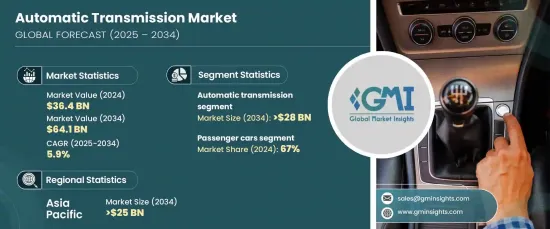
자동 변속기 세계 시장 규모는 2024년 364억 달러로 평가되었으며, 2025년부터 2034년 사이에 5.9%의 강력한 연평균 복합 성장률(CAGR)로 성장할 것으로 예상됩니다.
이러한 성장은 편의성, 연비 효율, 뛰어난 운전 쾌적성에 대한 소비자 수요 증가를 기여합니다. 배기 가스 규제 강화로 자동차 제조업체는 연비를 향상시키고 엄격한 기준을 충족하는 고급 변속기 기술을 채택하고 있습니다. 게다가 하이브리드 자동차와 전기자동차의 채용이 증가하고 있는 것도 성능과 효율을 최적화하도록 설계된 특수한 변속기 시스템의 기술 혁신에 박차를 가하고 있습니다.
활기찬 물류업계와 건설 업계는 상용차의 자동 변속기 수요를 크게 끌어 올리고 있습니다. 이 시스템은 성능을 향상시키고 드라이버의 피로를 줄이고 연료 효율을 높이기 때문에 대형 용도에 필수적입니다. 함대 운영자는 비즈니스 효율성 목표를 달성하고 엄격한 배출 가스 규정을 준수하기 위해 첨단 변속기 기술에 점점 더 많은 관심을 기울이고 있습니다.
시장 범위
시작연도
2024
예측연도
2025-2034
시작금액
364억 달러
예측 금액
641억 달러
CAGR
5.9%
시장은 자동 변속기, 무단 변속기(CVT), 듀얼 클러치 변속기(DCT), 자동 수동 변속기(AMT)로 구분됩니다. 2024년에는 자동 변속기 부문이 46%의 압도적인 시장 점유율을 차지했고 2034년까지 280억 달러를 창출할 것으로 예상됩니다. 이 부문의 성장은 신뢰성, 원활한 변속 기능 및 편안함으로 인해 특히 승용차에 선호됩니다. 대기업은 고성능과 저배출 가스를 요구하는 소비자의 기호에 응하기 위해 다단 기어와 효율 향상을 특징으로 하는 시스템으로 혁신을 진행하고 있습니다.
판매 채널별로 시장은 승용차와 상용차로 나뉩니다. 승용차는 보다 부드러운 핸들링, 보다 높은 주행 쾌적성, 연비 개선에 대한 소비자의 취향의 높아짐에 견인되어 2024년 시장 점유율은 67%라는 경이적인 숫자를 기록했습니다. 하이브리드 자동차와 전기자동차의 급속한 보급이 이러한 동향을 더욱 가속화하고 있으며, 이러한 자동차는 최적의 성능과 배출량 감축을 달성하기 위해 듀얼 클러치식 변속기 및 무단 변속기의 이용이 증가하고 있습니다.
2024년 아시아태평양의 자동 변속기 시장은 38%의 점유율을 차지했으며, 2034년에는 250억 달러에 이를 것으로 예상됩니다. 이 지역의 급속한 도시화, 중간층의 확대, 가처분 소득 증가가 자동 변속기를 탑재한 자동차에 대한 수요를 높이고 있습니다. 소비자는 특히 승용차에 있어서 연비 효율과 쾌적성을 우선하고 있어, 이것이 채용 가속으로 이어지고 있습니다. 게다가 이 지역에서는 전기자동차와 하이브리드 자동차 시장이 확대되고 있으며, 첨단 변속기 기술에 대한 수요가 높아지고 있습니다.
목차
제1장 조사 방법과 조사 범위
조사 디자인
조사 접근
데이터 수집 방법
기본 추정과 계산
기준연도의 산출
시장추계의 주요 동향
예측 모델
1차 조사와 검증
1차 정보
데이터 마이닝 소스
시장 정의
제2장 주요 요약
제3장 업계 인사이트
생태계 분석
공급자의 상황
원재료 공급자
부품 공급자
제조업체
OEM
유통 및 애프터마켓 공급업체
최종 사용자
이익률 분석
기술과 혁신의 전망
코스트 내역 분석
주요 뉴스와 대처
규제 상황
기술의 차별화 요인
연료 효율
시프트 속도와 운전 체험
비용 대비 효과
내구성과 유지보수
영향요인
성장 촉진요인
연비와 편안함에 대한 수요 증가
하이브리드차나 전기차의 채용 증가
기어 시스템의 기술적 진보
도시 환경의 수동 변속기보다 자동 변속기에 대한 소비자의 선호.
업계의 잠재적 위험 및 과제
고급 자동 변속기의 고비용
유지 보수 및 수리의 복잡성
성장 가능성 분석
Porter's Five Forces 분석
PESTEL 분석
제4장 경쟁 구도
소개
기업 점유율 분석
경쟁 포지셔닝 매트릭스
전략 전망 매트릭스
제5장 시장 추정 및 예측 : 변속기별, 2021년-2034년
주요 동향
자동 변속기(AT)
무단 변속 변속기(CVT)
듀얼 클러치 변속기(DCT)
자동 수동 변속기(AMT)
제6장 시장 추정 및 예측 : 연료별, 2021년-2034년
주요 동향
가솔린
디젤
하이브리드
제7장 시장 추정 및 예측 : 판매 채널별, 2021-2034년
주요 동향
OEM
애프터마켓
제8장 시장 추정 및 예측 : 차종별, 2021년-2034년
주요 동향
승용차
해치백
세단
SUV
상용차
LCV
HCV
제9장 시장 추정 및 예측 : 지역별, 2021년-2034년
주요 동향
북미
미국
캐나다
유럽
영국
독일
프랑스
스페인
이탈리아
러시아
북유럽
아시아태평양
중국
인도
일본
한국
뉴질랜드
동남아시아
라틴아메리카
브라질
멕시코
아르헨티나
중동 및 아프리카
UAE
남아프리카
사우디아라비아
제10장 기업 프로파일
Aisin Seiki
Allison Transmission
BorgWarner
Continental
Eaton
Ford Motor Company
General Motors
Getrag
Honda Motor
Hyundai Transys
Jatco
Magna International
PSA Group
Ricardo
Schaeffler
Tremec
Valeo
Voith
Volkswagen
ZF Friedrichshafen
SHW
영문 목차
영문목차
The Global Automatic Transmission Market was valued at USD 36.4 billion in 2024 and is forecasted to grow at a robust CAGR of 5.9% between 2025 and 2034. This growth is fueled by increasing consumer demand for convenience, fuel efficiency, and superior driving comfort. Stricter emissions regulations are driving automakers to adopt advanced transmission technologies that enhance fuel economy and meet stringent standards. Additionally, the rising adoption of hybrid and electric vehicles is spurring innovation in specialized transmission systems designed to optimize performance and efficiency.
The booming logistics and construction industries are significantly boosting the demand for automatic transmissions in commercial vehicles. These systems improve performance, reduce driver fatigue, and enhance fuel efficiency, making them indispensable for heavy-duty applications. Fleet operators are increasingly turning to advanced transmission technologies to meet operational efficiency goals and comply with stringent emissions norms.
Market Scope
Start Year
2024
Forecast Year
2025-2034
Start Value
$36.4 Billion
Forecast Value
$64.1 Billion
CAGR
5.9%
The market is segmented into automatic transmission, continuously variable transmission (CVT), dual-clutch transmission (DCT), and automated manual transmission (AMT). In 2024, the automatic transmission segment held a dominant 46% market share and is projected to generate USD 28 billion by 2034. This segment's growth is attributed to its reliability, seamless shifting capabilities, and comfort-especially favored in passenger vehicles. Leading manufacturers are innovating with systems that feature multiple gears and enhanced efficiency, catering to consumer preferences for high performance and lower emissions.
By sales channel, the market is divided into passenger cars and commercial vehicles. Passenger cars accounted for an impressive 67% market share in 2024, driven by growing consumer preferences for smoother handling, greater driving comfort, and improved fuel economy. The rapid rise in hybrid and electric vehicle adoption further accelerates this trend, with these vehicles increasingly utilizing dual-clutch and continuously variable transmissions to achieve optimal performance and reduced emissions.
In 2024, the Asia Pacific automatic transmission market contributed a substantial 38% market share and is projected to reach USD 25 billion by 2034. The region's rapid urbanization, expanding middle class, and rising disposable incomes are driving higher demand for vehicles equipped with automatic transmissions. Consumers prioritize fuel efficiency and comfort, particularly in passenger vehicles, leading to accelerated adoption. Furthermore, the growing market for electric and hybrid vehicles in the region underscores the demand for advanced transmission technologies.
Table of Contents
Chapter 1 Methodology & Scope
1.1 Research design
1.1.1 Research approach
1.1.2 Data collection methods
1.2 Base estimates and calculations
1.2.1 Base year calculation
1.2.2 Key trends for market estimates
1.3 Forecast model
1.4 Primary research & validation
1.4.1 Primary sources
1.4.2 Data mining sources
1.5 Market definition
Chapter 2 Executive Summary
2.1 Industry 3600 synopsis, 2021 - 2034
Chapter 3 Industry Insights
3.1 Industry ecosystem analysis
3.2 Supplier landscape
3.2.1 Raw Material suppliers
3.2.2 Component suppliers
3.2.3 Manufacturers
3.2.4 OEM
3.2.5 Distribution and aftermarket suppliers
3.2.6 End-Users
3.3 Profit margin analysis
3.4 Technology & innovation landscape
3.5 Cost breakdown analysis
3.6 Key news & initiatives
3.7 Regulatory landscape
3.8 Technology differentiators
3.8.1 Fuel efficiency
3.8.2 Shift speed and driving experience
3.8.3 Cost-effectiveness
3.8.4 Durability and maintenance
3.9 Impact forces
3.9.1 Growth drivers
3.9.1.1 Increasing demand for fuel efficiency and comfort
3.9.1.2 Rising adoption of hybrid and electric vehicles
3.9.1.3 Technological advancements in gear systems
3.9.1.4 Consumer preference for automatic over manual transmissions in urban environments
3.9.2 Industry pitfalls & challenges
3.9.2.1 High cost of advanced automatic transmissions