Aesthetic Medicine Market Opportunity, Growth Drivers, Industry Trend Analysis, and Forecast 2026 - 2035
상품코드:1892805
리서치사:Global Market Insights Inc.
발행일:2025년 12월
페이지 정보:영문 199 Pages
라이선스 & 가격 (부가세 별도)
ㅁ Add-on 가능: 고객의 요청에 따라 일정한 범위 내에서 Customization이 가능합니다. 자세한 사항은 문의해 주시기 바랍니다.
한글목차
세계의 미용 의료 시장은 2025년에 232억 달러로 평가되었고, 2035년까지 연평균 복합 성장률(CAGR) 13.5%로 성장하여 802억 달러에 이를 것으로 예측됩니다.
미용 의료에 대한 소비자의 인식 개선, 미용 의료 기기의 지속적인 기술 혁신, 비만율 증가, 비침습적 시술에 대한 선호도 증가 등이 시장의 급속한 성장을 견인하고 있습니다. 미용 의료은 최소 침습적 또는 비수술적 개입을 통해 신체적 외모를 개선하는 데 초점을 맞추고 주름, 색소 침착, 피부 질, 모발 재생, 바디 컨투어링과 같은 문제를 해결합니다. 비만 증가는 중요한 촉진요인이 되고 있으며, 기존의 체중 감량 방법을 넘어선 신체 형성 및 개선에 대한 수요가 증가하고 있습니다. 비만은 건강과 자존감 모두에 영향을 미치기 때문에 지방흡입, 복부성형, 바디컨투어링, 비침습적 지방감소술 등의 시술에 대한 수요가 급증하고 있습니다. 이 분야에서는 피부 처짐, 셀룰라이트, 흉터, 과도한 지방, 불필요한 체모, 색소침착 등을 개선하기 위해 수술적 방법과 비수술적 방법을 결합하여 외모와 자신감을 모두 향상시키는 것을 목표로 하고 있습니다.
시장 범위
개시 연도
2025년
예측 연도
2026-2035년
개시 연도 시장 규모
232억 달러
예측 금액
802억 달러
CAGR
13.5%
외과 수술 부문은 2025년 47억 달러에 달할 것으로 예상되며, 2035년에는 166억 달러에 달할 것으로 전망됩니다. 이러한 시술은 얼굴 회춘, 바디 컨투어링, 가슴성형, 코성형 등 외모에 큰 변화를 원하는 환자들에게 장기적이고 혁신적인 결과를 가져다주는 종합적인 솔루션을 제공합니다.
에너지 기반 부문은 2025년 56억 달러를 차지할 것으로 예측됩니다. 이러한 솔루션은 다운타임을 최소화하면서 정밀한 비침습적 또는 저침습적 치료를 제공합니다. 레이저, 고주파, 초음파, 고강도 펄스광(IPL) 등 첨단 기술을 활용한 에너지 기반 장비는 피부 회춘, 제모, 문신제거, 바디 컨투어링 등 다양한 뷰티 고민에 대응합니다.
북미 미용 의료 시장은 2024년 39.5%의 점유율을 차지했습니다. 이 지역의 성장은 소비자의 의식 향상, 첨단 기술의 보급, 그리고 외모를 중시하는 문화적 배경에 의해 뒷받침되고 있습니다. 미용 시술에 대한 관심이 높은 대규모 인구가 외과적 및 비외과적 개입에 대한 수요를 주도하고 있습니다.
목차
제1장 조사 방법과 범위
제2장 주요 요약
제3장 업계 인사이트
생태계 분석
업계에 대한 영향요인
성장 촉진요인
업계의 잠재적 리스크&과제
시장 기회
성장 가능성 분석
규제 상황
기술적 진보
현재 기술 동향
신기술
공급망 분석
상환 상황
가격 분석, 2025
향후 시장 동향
갭 분석
Porter's Five Forces 분석
PESTEL 분석
제4장 경쟁 구도
서론
기업의 시장 점유율 분석
기업 매트릭스 분석
주요 시장 기업의 경쟁 분석
경쟁 포지셔닝 매트릭스
주요 발전
인수합병(M&A)
제휴 및 공동 사업
신제품 발매
확대 계획
제5장 시장 추산 및 예측 : 유형별, 2022-2035
주요 동향
외과적 시술
비외과적 시술
제6장 시장 추산 및 예측 : 제품별, 2022-2035
주요 동향
에너지 기반 제품
레이저 미용 기기
고주파(RF) 기반 미용 기기
광 기반 미용 기기
초음파 미용 기기
기타 에너지 기반 제품
비에너지 기반
보툴리눔톡신(보톡스)
더말 필러
임플란트
안면 임플란트
유방 임플란트
기타 임플란트
기타 비에너지 기반 제품
제7장 시장 추산 및 예측 : 성별, 2022-2035
주요 동향
남성
18세 이하
19-34세
35-50세
51-64세
65세 이상
여성
18세 이하
19-34세
35-50세
51-64세
65세 이상
제8장 시장 추산 및 예측 : 최종 용도별, 2022-2035
주요 동향
병원
외래수술센터(ASC)
미용 센터 및 메디컬 스파
피부과 클리닉
재택치료 환경
제9장 시장 추산 및 예측 : 지역별, 2022-2035
주요 동향
북미
미국
캐나다
유럽
독일
영국
프랑스
스페인
이탈리아
네덜란드
아시아태평양
중국
인도
일본
호주
한국
라틴아메리카
브라질
멕시코
아르헨티나
중동 및 아프리카
사우디아라비아
남아프리카공화국
아랍에미리트(UAE)
제10장 기업 개요
Apax Partners
Boston Scientific Corporation
Bausch Health Companies Inc.
El.En. S.p.A
GC Aesthetics plc
Huadong Medicine Co., Ltd
Johnson &Johnson
Merz Pharma
Sciton, Inc.
SharpLight Technologies Inc
Sisram Medical Ltd
Vitruvian Partners LLP
LSH
영문 목차
영문목차
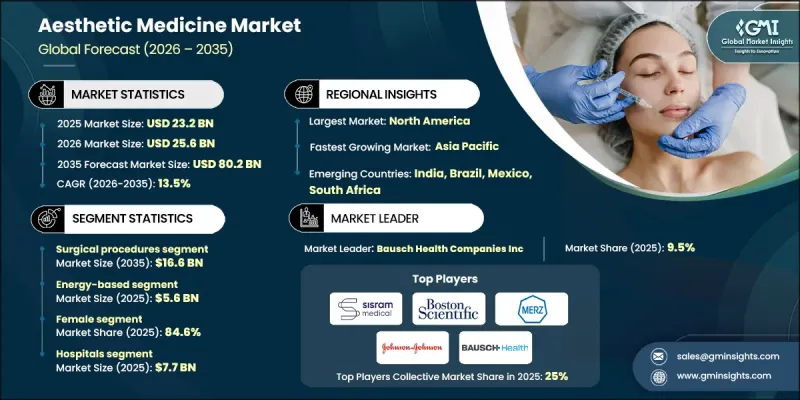
The Global Aesthetic Medicine Market was valued at USD 23.2 billion in 2025 and is estimated to grow at a CAGR of 13.5% to reach USD 80.2 billion by 2035.
The market's rapid expansion is fueled by increasing consumer awareness of aesthetic treatments, continuous technological innovations in medical aesthetic devices, rising obesity rates, and a growing preference for non-invasive procedures. Aesthetic medicine focuses on enhancing physical appearance through minimally invasive or non-surgical interventions, addressing concerns such as wrinkles, pigmentation, skin texture, hair restoration, and body contouring. The growing prevalence of obesity has become a significant driver, as individuals seek solutions to reshape and refine their bodies beyond traditional weight-loss methods. With obesity affecting both health and self-esteem, demand for treatments like liposuction, tummy tucks, body contouring, and non-invasive fat reduction is surging. The field combines surgical and non-surgical techniques to correct skin laxity, cellulite, scars, excess fat, unwanted hair, and hyperpigmentation, aiming to improve both appearance and confidence.
Market Scope
Start Year
2025
Forecast Year
2026-2035
Start Value
$23.2 Billion
Forecast Value
$80.2 Billion
CAGR
13.5%
The surgical procedures segment reached USD 4.7 billion in 2025 and is projected to reach USD 16.6 billion by 2035. These procedures provide comprehensive solutions for concerns including facial rejuvenation, body contouring, breast augmentation, and rhinoplasty, offering long-lasting and transformative results for patients seeking significant changes in appearance.
The energy-based segment accounted for USD 5.6 billion in 2025. These solutions offer precise, non-invasive or minimally invasive treatments with minimal downtime. Utilizing advanced technologies such as lasers, radiofrequency, ultrasound, and intense pulsed light (IPL), energy-based devices address a variety of cosmetic concerns, including skin rejuvenation, hair removal, tattoo removal, and body contouring.
North America Aesthetic Medicine Market held a 39.5% share in 2024. Growth in the region is supported by heightened consumer awareness, widespread adoption of advanced technologies, and a cultural emphasis on physical appearance. A large population with significant interest in cosmetic procedures is driving demand for both surgical and non-surgical interventions.
Key players operating in the Global Aesthetic Medicine Market include Johnson & Johnson, Boston Scientific Corporation, Huadong Medicine Co., Ltd, GC Aesthetics plc, Apax Partners, SharpLight Technologies Inc., Sisram Medical Ltd, Bausch Health Companies Inc., Merz Pharma, Vitruvian Partners LLP, and El.En. S.p.A. Companies in the Global Aesthetic Medicine Market are strengthening their presence by investing in research and development to create innovative, minimally invasive devices with higher efficacy and lower recovery times. Strategic partnerships and collaborations with distributors and healthcare providers are enhancing market reach and patient access. Firms are also focusing on expanding into emerging regions, offering training programs for clinicians, and integrating digital solutions such as AI-assisted treatment planning. Sustainability initiatives, personalized treatment options, and product diversification are being used to differentiate offerings and build long-term brand loyalty, while targeted marketing campaigns raise consumer awareness and drive adoption of advanced aesthetic procedures.