



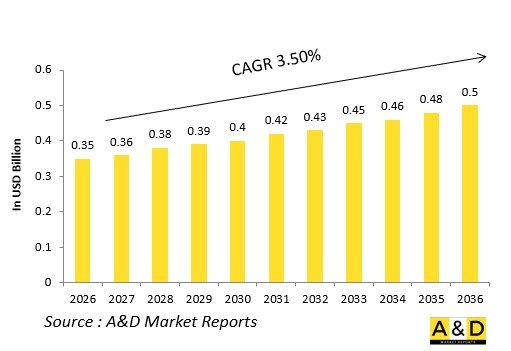
세계 방위용 엔진 오일 냉각 시스템 시장 규모는 2026년 3억 5,000만 달러에서 2026년부터 2036년까지 예측 기간 동안 3.50%의 CAGR로 성장할 것으로 예상되며, 2036년에는 5억 달러에 달할 것으로 예상됩니다.
소개
세계 방위용 엔진 오일 냉각 시스템 시장은 전투 기동 및 무기창 개폐로 인한 가혹한 열 부하 하에서 베어링과 기어를 보호하기 위해 윤활유 온도를 제어합니다. 에어 오일 쿨러는 바이패스 공기와 열교환을 하고, 연료 오일 교환기는 순항 중 케로신의 능력을 활용합니다.
지정학적 영공권 확보 전략이 개발을 추진하고 있으며, 지향성 에너지 무기와 합성 윤활유와 호환되는 시스템이 우선시되고 있습니다. 개방형 아키텍처를 통해 엔진을 재설계하지 않고도 기술 도입이 가능합니다. 공급망은 티타늄 브레이징 및 내식성 코팅에 중점을 둡니다. 경쟁 상황에서는 Honeywell, Collins Aerospace, Safran이 선구적인 램 공기 회수 설계를 특징으로 합니다.
방위용 엔진 오일 냉각 시스템 : 기술의 영향
마이크로 채널 열교환기는 기존 엔벨로프 내에서 표면적을 두 배로 늘리고, 층류 최적화를 통해 방열량을 두 배로 늘렸습니다. 2차 루프의 상변화 재료는 애프터버너 점화 시 과도적인 부하를 흡수하여 주회로의 오일 온도를 안정화시킵니다.
일렉트로크로믹 가변 지오메트리 루버는 램 공기 흡입구를 자율적으로 조정하여 상승 시 회수를 극대화하는 동시에 호버링 시 항력을 최소화합니다. 볼텍스 제너레이터가 장착된 연료 냉각식 오일 쿨러는 케로신 측의 대류를 강화하여 보조 송풍기 없이도 열을 배출합니다.
내장된 광섬유 분산 온도 센서가 FADEC 폐쇄 루프 제어에 정보를 공급하여 지속적 최대 출력 시 코킹을 방지합니다. 추가 제작을 통한 격자형 핀이 공기 측 효율을 향상시키면서 무게를 크게 줄였습니다. 열용량을 두 배로 늘린 합성 에스테르 윤활유에 의해 고온 샘플링을 실현하고 있습니다.
예측 알고리즘이 코어 간 온도차 패턴을 분석하여 바이패스 작동 전에 필터를 교체하도록 유도합니다. 하이브리드 전기 아키텍처에서는 터빈 윤활유 외에 모터 오일을 위한 이중 루프 냉각이 필요합니다. 디지털 트윈 기술을 통해 전투로 인해 손상된 흡기 흐름 하에서 열교환기 성능을 검증합니다. 이를 통해 모든 임무 프로파일을 통해 윤활의 연속성을 보장합니다.
방위용 엔진오일 냉각 시스템 : 주요 촉진요인
적응형 사이클 엔진은 기존 한계를 초과하는 섬프 온도를 발생시키기 때문에 현재의 연료 냉각 용량을 뛰어넘는 첨단 열교환기가 필수적입니다. 6세대 무인 플랫폼은 파일럿의 개입 없이 자율적인 열 관리를 요구합니다.
유지보수는 코어의 모듈화를 우선시하고, 정기적인 엔진 탈착을 배제합니다. 수출 프로그램에서는 다양한 케로신 혼합 연료에 대응하는 광범위한 연료 호환성이 요구됩니다. 슈퍼 크루즈와 애프터버너의 사이클 운전은 기존 쿨러의 한계를 넘어서는 부하를 발생시킵니다.
예산 측면에서는 군용 표준을 강화한 상용 파생품의 채택이 유리합니다. 공급 탄력성 확보를 위해 3D 프린팅 대체품으로 티타늄의 제약을 극복합니다. 상호운용성을 통해 연합군 엔진 간 공통 코어를 구현할 수 있습니다.
지향성 에너지 무기의 열 추출은 메가 와트급 열 부하를 발생시키기 때문에 병렬 냉각 경로가 필요합니다. 이로 인해 오일 냉각은 열역학적 실현 수단으로 자리매김하고 있습니다.
세계의 방위용 엔진 오일 냉각 시스템 시장을 조사했으며, 주요 동향, 시장 영향요인, 주요 기술 및 그 영향력, 주요 지역 및 국가별 동향, 시장 기회 분석 등의 정보를 전해드립니다.
The Global Defense Engine Oil Cooling Systems Market is estimated at USD 0.35 billion in 2026, projected to grow to USD 0.5 billion by 2036 at a Compound Annual Growth Rate (CAGR) of 3.50% over the forecast period 2026-2036.
Introduction
The global Defense Engine Oil Cooling Systems market regulates lubricant temperatures to protect bearings and gears under extreme thermal loads from combat maneuvers and weapons bay openings. Air-oil coolers exchange heat with bypass air, while fuel-oil exchangers leverage kerosene's capacity during cruise.
Geopolitical air superiority campaigns drive development, prioritizing systems compatible with directed-energy weapons and synthetic lubricants. Open architectures support technology insertion without engine redesigns. Supply chains focus on titanium brazing and corrosion-resistant coatings. Competition features Honeywell, Collins Aerospace, and Safran pioneering ram-air recovery designs.
Technology Impact in Defense Engine Oil Cooling Systems
Microchannel heat exchangers multiply surface area within existing envelopes, doubling heat rejection via laminar flow optimization. Phase-change materials in secondary loops absorb transient loads during afterburner lighting, stabilizing primary oil temperatures.
Electrochromic variable-geometry louvers modulate ram-air intake autonomously, maximizing recovery during climbs while minimizing drag in loiter. Fuel-cooled oil coolers with vortex generators enhance kerosene-side convection, rejecting heat without auxiliary blowers.
Embedded fiber-optic distributed temperature sensors feed FADEC closed-loop control, preempting coking during sustained max power. Additively manufactured lattice fins boost air-side effectiveness while slashing weight. Synthetic ester lubricants with doubled thermal capacity enable hotter sumps.
Predictive algorithms analyze delta-T signatures across cores, cueing filter swaps before bypass activation. Hybrid electric architectures demand dual-loop cooling for motor oils alongside turbine lubricants. Digital twins validate exchanger performance under battle-damaged inlet flows. These ensure continuous lubrication throughout mission profiles.
Key Drivers in Defense Engine Oil Cooling Systems
Adaptive cycle engines generate sump temperatures exceeding legacy limits, mandating advanced exchangers beyond current fuel-cooled capacity. Sixth-generation unmanned platforms require autonomous thermal management without pilot override.
Sustainment prioritizes core modularization eliminating scheduled engine removals. Export programs demand wide-cut fuel compatibility across kerosene blends. Supercruise-afterburner cycling stresses conventional coolers beyond margins.
Budget favors commercial derivatives with mil-spec hardening. Supply resilience counters titanium constraints via 3D-printed alternatives. Interoperability enables common cores across coalition engines.
Directed-energy extraction creates megawatt thermal loads requiring parallel cooling paths. These position oil cooling as thermodynamic enablers.
Regional Trends in Defense Engine Oil Cooling Systems
North America leads F-35 sustainment, pioneering fuel-cooled architectures for STOVL profiles.
Europe upgrades Rafale/Typhoon exchangers for synthetic lubricants in dispersed basing.
Asia-Pacific surges with indigenous programs-India's Kaveri, China's WS-15-prioritizing high-altitude heat rejection.
Middle East adapts coatings for sand-contaminated oils.
Russia hardens exchangers for Su-57 sustained afterburner.
South Korea integrates KF-21 exports with common cores.
Trends favor microchannel designs; Asia-Pacific captures manufacturing growth.
Key Defense Engine Oil Cooling Systems Programs
F135 fuel-oil cooler sustains STOVL transitions and afterburner via vortex-enhanced kerosene flow.
NGAD adaptive exchangers schedule cooling with third-stream modulation.
EJ200 upgrades reject supercruise heat through variable-geometry air-oil cores.
Kaveri equips Tejas with indigenous ram-air recovery.
F119 exchangers enable stealth missions with minimized drag louvers.
Rafale M88 integrates carrier catapult thermal surge protection.
Su-57 AL-41F1 handles thrust-vectoring oil heating.
T-50 FADEC-controlled bypass prevents sump overtemperature.
By Platform
By Cooling Method
By System Integration
The 10-year Defense Engine Oil Cooling Systems market analysis would give a detailed overview of Defense Engine Oil Cooling Systems market growth, changing dynamics, technology adoption overviews and the overall market attractiveness is covered in this chapter.
This segment covers the top 10 technologies that is expected to impact this market and the possible implications these technologies would have on the overall market.
The 10-year Defense Engine Oil Cooling Systems market forecast of this market is covered in detailed across the segments which are mentioned above.
The regional counter drone market trends, drivers, restraints and Challenges of this market, the Political, Economic, Social and Technology aspects are covered in this segment. The market forecast and scenario analysis across regions are also covered in detailed in this segment. The last part of the regional analysis includes profiling of the key companies, supplier landscape and company benchmarking. The current market size is estimated based on the normal scenario.
North America
Drivers, Restraints and Challenges
PEST
Key Companies
Supplier Tier Landscape
Company Benchmarking
Europe
Middle East
APAC
South America
This chapter deals with the key defense programs in this market, it also covers the latest news and patents which have been filed in this market. Country level 10 year market forecast and scenario analysis are also covered in this chapter.
US
Defense Programs
Latest News
Patents
Current levels of technology maturation in this market
Canada
Italy
France
Germany
Netherlands
Belgium
Spain
Sweden
Greece
Australia
South Africa
India
China
Russia
South Korea
Japan
Malaysia
Singapore
Brazil
The opportunity matrix helps the readers understand the high opportunity segments in this market.
Hear from our experts their opinion of the possible analysis for this market.