



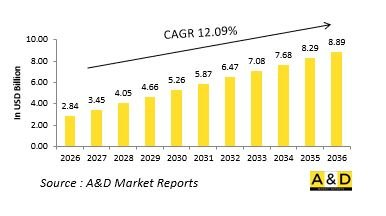
세계의 방위용 AR 및 VR 시장 규모는 2026년에 추정 28억 4,000만 달러이며, 2036년까지 88억 9,000만 달러에 달할 것으로 예측되며, 2026-2036년 예측 기간 동안 CAGR로 12.09%의 성장이 전망됩니다.
소개
증강현실(AR) 및 가상현실(VR) 기술은 현대 군사 환경에서 국방부대의 훈련, 계획 및 작전 방식을 점점 더 변화시키고 있습니다. 이러한 몰입형 기술을 통해 인원을 현실 세계의 위험에 노출시키지 않고도 현실적인 전투 시나리오 시뮬레이션, 작전 리허설, 기술 개발을 할 수 있습니다. 국방 분야에서 증강현실은 물리적 환경에 디지털 정보를 중첩하여 실제 전투 작전을 강화하며, 가상현실은 완전히 몰입형 훈련 및 계획 공간을 창출합니다. 이러한 기술 채택은 군대 내 디지털 혁신과 데이터 기반 의사결정으로의 광범위한 전환을 반영합니다. 작전의 복잡성이 증가함에 따라 국방 조직은 준비태세 향상, 훈련 비용 절감, 인지 능력 강화를 위한 도구를 필요로 하고 있습니다. AR-VR 솔루션은 병사 개개인의 훈련, 지휘관의 계획 수립, 정비 지원, 작전 시뮬레이션에 걸쳐 통합되고 있습니다. 다양한 환경과 상황을 재현하는 이러한 기술은 지리적으로 분산된 부대에서 일관된 훈련 기준을 유지할 수 있게 해줍니다. 이러한 기술은 평시와 전쟁 모두에서 준비태세와 작전 효과를 실현하는 데 필수적인 요소로 인식되고 있습니다.
방위용 AR 및 VR 기술이 국방에 미치는 영향
기술 발전으로 방위용 AR 및 VR의 능력과 현실성은 빠르게 확대되고 있습니다. 디스플레이 해상도, 모션 트래킹, 공간 매핑의 개선으로 고도로 몰입감 있고 정확한 훈련 환경을 조성하고 있습니다. 처리 능력의 향상으로 복잡한 상황과 역동적인 상호작용을 실시간으로 렌더링할 수 있습니다. AI는 사용자의 행동과 성능에 반응하여 적응형 훈련 모듈을 강화합니다. 클라우드 기반 아키텍처는 부대 간 확장 가능한 배포와 원격 협업을 지원합니다. 센서 데이터 및 작전 시스템과의 통합을 통해 증강현실은 훈련 및 실전 작전 중에 실시간 상황 인식을 제공합니다. 촉각 피드백 기술은 물리적 상호 작용을 시뮬레이션하여 현실감을 향상시킵니다. 가벼운 인체공학적 디자인의 하드웨어는 사용자의 편안함과 접근성을 높여줍니다. 이러한 기술 개발로 AR-VR 시스템은 전술 훈련부터 전략 계획까지 다양한 국방 기능을 지원할 수 있게 됩니다.
방위용 AR 및 VR의 주요 추진 요인
여러 요인이 국방 조직에서 AR-VR 기술 채택을 촉진하고 있습니다. 비용 효율적이고 반복 가능한 훈련 솔루션의 필요성이 실제 훈련에 대한 의존도를 낮추는 가상 환경에 대한 투자를 촉진하고 있습니다. 작전이 복잡해지면서 의사결정 능력과 인지적 준비태세를 강화할 수 있는 도구가 요구되고 있습니다. 국방 기관은 안전 위험을 최소화하면서 훈련의 현실성을 향상시키는 것을 목표로 하고 있습니다. 기술의 급속한 발전과 디지털 네이티브 세대의 인재가 더 많은 채용을 촉진하고 있습니다. 정비 및 물류 훈련에서 증강현실을 통한 안내는 효율성을 높이고 실수를 줄이는 데 효과적입니다. 상호 운용성과 공동 훈련에 대한 요구 사항도 표준화된 몰입형 솔루션에 대한 수요를 촉진하고 있습니다. 또한, 지속적인 준비 태세와 신속한 기술 개발에 집중하여 AR-VR 기술에 대한 장기적인 관심을 유지하고 있습니다. 이러한 촉진요인으로 인해 몰입형 기술은 현대 국방 역량 개발에 필수적인 요소로 자리 잡고 있습니다.
방위용 AR 및 VR의 지역적 트렌드
지역의 국방 우선순위는 AR과 VR의 도입 속도와 중점 사항에 영향을 미칩니다. 북미의 국방 조직은 첨단 훈련 및 작전 계획 시스템에 몰입형 기술을 통합하는 데 있어 선도적인 위치를 차지하고 있습니다. 유럽 군대는 다국적 작전을 지원하는 공동 훈련 플랫폼을 중시하고 있습니다. 아시아태평양 국가들은 확장되는 부대 구조와 다양한 작전 환경을 지원하는 확장 가능한 솔루션에 초점을 맞추고 있습니다. 중동의 국방 조직은 즉각적인 대응 태세와 전문 훈련을 강화하기 위해 몰입형 기술에 투자하고 있습니다. 아프리카 군대는 준비태세 향상을 위해 비용 효율적인 가상훈련 솔루션을 적극적으로 모색하고 있습니다. 지역을 불문하고 기술 제공업체와의 파트너십과 현지 개발 노력이 확대되고 있습니다. 이러한 추세는 AR-VR이 국방 준비태세를 혁신하는 도구로 전 세계적으로 인식되고 있음을 보여줍니다.
세계의 방위용 AR 및 VR 시장에 대해 조사 분석했으며, 시장에 영향을 미치는 기술, 향후 10년간의 예측, 각 지역별 동향 등의 정보를 전해드립니다.
지역별
구성요소별
북미
촉진요인, 억제요인, 과제
PEST
주요 기업
공급업체 Tier 상황
기업 벤치마크
유럽
중동
아시아태평양
남미
미국
방위 프로그램
최신 뉴스
특허
이 시장의 현재 기술 성숙도
캐나다
이탈리아
프랑스
독일
네덜란드
벨기에
스페인
스웨덴
그리스
호주
남아프리카공화국
인도
중국
러시아
한국
일본
말레이시아
싱가포르
브라질
The Global AR and VR market is estimated at USD 2.84 billion in 2026, projected to grow to USD 8.89 billion by 2036 at a Compound Annual Growth Rate (CAGR) of 12.09% over the forecast period 2026-2036.
Introduction
Augmented reality and virtual reality technologies are increasingly reshaping how defense forces train, plan, and operate across modern military environments. These immersive technologies enable realistic simulation of combat scenarios, mission rehearsal, and skill development without exposing personnel to real-world risk. In defense applications, augmented reality enhances live operations by overlaying digital information onto physical environments, while virtual reality creates fully immersive training and planning spaces. The adoption of these technologies reflects a broader shift toward digital transformation and data-driven decision-making within armed forces. As operational complexity increases, defense organizations seek tools that improve preparedness, reduce training costs, and enhance cognitive performance. AR and VR solutions are being integrated across individual soldier training, command staff planning, maintenance support, and mission simulation. Their ability to replicate diverse environments and scenarios supports consistent training standards across geographically dispersed forces. These technologies are increasingly recognized as essential enablers of readiness and operational effectiveness in both peacetime and combat contexts.
Technology Impact in AR and VR Defense
Technological advancements are rapidly expanding the capabilities and realism of AR and VR defense applications. Improvements in display resolution, motion tracking, and spatial mapping create highly immersive and accurate training environments. Advances in processing power enable real-time rendering of complex scenarios and dynamic interactions. Artificial intelligence enhances adaptive training modules by responding to user behavior and performance. Cloud-based architectures support scalable deployment and remote collaboration across units. Integration with sensor data and operational systems allows augmented reality to deliver real-time situational awareness during exercises and live missions. Haptic feedback technologies improve realism by simulating physical interactions. Lightweight and ergonomic hardware designs increase user comfort and accessibility. These technological developments enable AR and VR systems to support a wide range of defense functions, from tactical training to strategic planning.
Key Drivers in AR and VR Defense
Several factors are driving the adoption of AR and VR technologies within defense organizations. The need for cost-effective and repeatable training solutions encourages investment in virtual environments that reduce reliance on live exercises. Increasing operational complexity requires tools that enhance decision-making and cognitive readiness. Defense forces seek to improve training realism while minimizing safety risks. Rapid technology evolution and digital-native personnel further support adoption. Maintenance and logistics training benefit from augmented reality guidance, improving efficiency and reducing errors. Interoperability and joint training requirements also drive demand for standardized immersive solutions. Additionally, the emphasis on continuous readiness and rapid skill development sustains long-term interest in AR and VR technologies. These drivers collectively position immersive technologies as integral components of modern defense capability development.
Regional Trends in AR and VR Defense
Regional defense priorities influence the pace and focus of AR and VR adoption. North American defense organizations lead in integrating immersive technologies into advanced training and mission planning systems. European forces emphasize collaborative training platforms that support multinational operations. Asia-Pacific countries focus on scalable solutions to support expanding force structures and diverse operational environments. Middle Eastern defense organizations invest in immersive technologies to enhance readiness and specialized training. African forces increasingly explore cost-efficient virtual training solutions to improve preparedness. Across regions, partnerships with technology providers and local development initiatives are expanding. These trends highlight the growing global recognition of AR and VR as transformative tools for defense readiness.
Anduril Industries received a $159 million U.S. Army contract in September 2025 to prototype next-generation mixed-reality headsets combining night vision, augmented reality overlays, and artificial intelligence processing. This award followed Anduril's takeover of Microsoft's troubled $22 billion Integrated Visual Augmentation System program earlier that year. The helmet-mounted display system aims to provide soldiers with real-time battlefield data, navigation cues, and target identification while maintaining situational awareness during day/night operations.
By Region
By Component
The 10-year AR & VR in defense market analysis would give a detailed overview of AR & VR in Defense Market growth, changing dynamics, technology adoption overviews and the overall market attractiveness is covered in this chapter.
This segment covers the top 10 technologies that is expected to impact this market and the possible implications these technologies would have on the overall market.
The 10-year AR & VR in Defense Market forecast of this market is covered in detailed across the segments which are mentioned above.
The regional AR & VR in Defense Market trends, drivers, restraints and Challenges of this market, the Political, Economic, Social and Technology aspects are covered in this segment. The market forecast and scenario analysis across regions are also covered in detailed in this segment. The last part of the regional analysis includes profiling of the key companies, supplier landscape and company benchmarking. The current market size is estimated based on the normal scenario.
North America
Drivers, Restraints and Challenges
PEST
Key Companies
Supplier Tier Landscape
Company Benchmarking
Europe
Middle East
APAC
South America
This chapter deals with the key defense programs in this market, it also covers the latest news and patents which have been filed in this market. Country level 10 year market forecast and scenario analysis are also covered in this chapter.
US
Defense Programs
Latest News
Patents
Current levels of technology maturation in this market
Canada
Italy
France
Germany
Netherlands
Belgium
Spain
Sweden
Greece
Australia
South Africa
India
China
Russia
South Korea
Japan
Malaysia
Singapore
Brazil
The opportunity matrix helps the readers understand the high opportunity segments in this market.
Hear from our experts their opinion of the possible analysis for this market.