



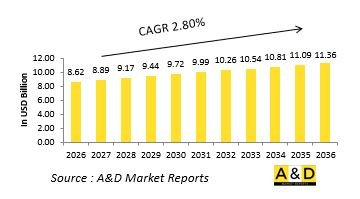
세계의 콜벳 시장 규모는 2026년에 약 86억 2,000만 달러로 추정되고, 2036년까지 113억 6,000만 달러에 이를 것으로 예측되며, 2026-2036년의 예측 기간에 CAGR 2.80%의 성장이 전망되고 있습니다.

코르벳 소개
코르벳은 연안 해역에서의 다목적 작전을 염두에 두고 설계된 다목적 해군 함정입니다. 호위함이나 구축함보다 작고 기동성이 뛰어나며 화력, 속도, 작전상 유연성의 균형을 제공합니다. 대수상전, 대잠수함 작전, 감시, 정찰, 해상보안 작전에 투입됩니다. 코르벳은 미사일 시스템, 어뢰, 함포, 전자전 장비를 조합한 무장을 갖추고 있어 다양한 위협에 대응하면서 대규모 함대작전을 지원할 수 있습니다. 컴팩트한 크기로 신속한 배치, 효율적인 유지관리, 대형 선박이 제한되는 얕은 수심이나 혼잡한 수역에서의 작전을 가능하게 합니다. 현대의 코르벳은 모듈식 설계로 건조되어 기뢰방어, 수륙양용작전 지원, 무인항공기 운용 등 특수작전으로 신속하게 전환이 가능합니다. 방어와 공격의 역할을 모두 수행하며, 대형 함정을 보완하면서 연안 방어와 지역 억지력을 제공합니다. 해상 위협이 진화하는 가운데, 코르벳은 전략적 해군 계획에서 점점 더 중요한 역할을 하고 있으며, 현대 해전에서 작전 다양성, 신속한 대응 능력, 높은 비용 효율성을 입증하고 있습니다. 코르벳에 대한 투자는 새로운 안보 도전에 대응하는 동시에 해군의 기동성을 유지하고 군사력을 투사하며 해상 무역로를 확보하기 위한 광범위한 노력을 반영하고 있습니다.
세계 코르벳에 미치는 기술의 영향
기술의 발전은 코르벳의 능력을 크게 향상시켜 작전 효율성, 전투 효과, 생존성을 높이고 있습니다. 현대식 추진 시스템은 고속화, 항속거리 연장, 정숙성 향상, 스텔스 및 전술적 유연성을 강화합니다. 첨단 센서, 레이더, 소나, 전자전 시스템의 통합을 통해 코르벳은 여러 표적을 동시에 정밀하게 감지, 추적, 공격할 수 있게 되었습니다. 모듈식 작전 베이와 유연한 무기 구성으로 대잠전, 수상전, 정찰 등 다양한 작전에 적응할 수 있습니다. 네트워크화된 통신 및 지휘 시스템은 상황 인식 능력을 강화하여 코르벳이 대형 함대, 무인 플랫폼, 항공 정찰기와 원활하게 협력할 수 있도록 합니다. 항해, 목표물 포착, 피해 대책의 자동화는 승무원의 부하를 줄이는 동시에 반응 시간과 신뢰성을 향상시킵니다. 경량 복합재료 및 내식성 합금과 같은 재료 혁신은 선체의 내구성을 향상시키고, 유지보수를 줄여 고속 작전을 지원합니다. 스텔스 기술과 시그니처 관리를 통해 감지 가능성을 줄이고 적대적인 환경에서의 생존성을 향상시킵니다. 지속적인 기술 업그레이드를 통해 코르벳은 새로운 위협에 대한 대응 능력을 유지하고, 차세대 무기를 통합하고, 진화하는 해군 전략에 적응할 수 있습니다. 종합적으로 이 기술은 현대 해상 방어에서 코르벳함의 작전적 다양성, 전력 투사 능력, 전략적 중요성을 강화합니다.
코르벳의 주요 촉진요인
여러 요인이 코르벳의 개발과 전 세계 보급을 촉진하고 있습니다. 연안 및 얕은 바다에서 운용할 수 있는 유연하고 신속한 대응 능력을 갖춘 해군 플랫폼의 필요성이 이러한 소형 전투함에 대한 투자를 촉진하고 있습니다. 비대칭 공격, 해적 행위, 영토 분쟁 등 현대의 해상 위협은 다양한 전투 작전, 감시 작전, 정찰 작전을 수행할 수 있는 함정을 요구합니다. 예산의 제약과 비용 효율성 측면에서 크고 값비싼 수상 전투함보다 코르벳이 선택되어 능력과 가격의 균형을 이루었습니다. 모듈식 설계, 추진체계, 센서, 무기체계의 발전으로 코르벳은 다양한 작전요구를 충족시키면서도 향후 업그레이드에 대응할 수 있는 적응성을 유지하고 있습니다. 해군 현대화 계획과 함대 확장 계획도 수요를 자극하고 있으며, 특히 해안 방어와 해양 안보 강화를 목표로 하는 지역에서 두드러지게 나타나고 있습니다. 코르벳은 네트워크화된 해군 작전에의 통합, 무인 시스템, 헬리콥터, 대형 수상함과의 상호 운용성을 통해 전술적 가치를 높이고 있습니다. 지정학적 경쟁, 새로운 안보 이슈, 신속한 배치와 병력투입에 대한 강조가 조달 계획을 더욱 촉진하고 있습니다. 작전 요건, 기술 발전, 비용 고려, 전략적 우선 순위가 결합되어 코르벳은 현대 해군 전략에서 중요한 자산으로 자리 잡았으며, 현대 해상 방어 전략에서 지속적인 중요성을 유지하고 있습니다.
세계의 코르벳 시장에 대해 조사 분석했으며, 시장에 영향을 미치는 기술, 향후 10년간의 예측, 각 지역별 동향 등의 정보를 전해드립니다.
유형별
지역별
클래스별
북미
성장 촉진요인, 억제요인, 과제
PEST
주요 기업
공급업체 Tier 상황
기업 벤치마킹
유럽
중동
아시아태평양
남미
미국
방위 프로그램
최신 뉴스
특허
이 시장에서의 현재 기술 성숙도
캐나다
이탈리아
프랑스
독일
네덜란드
벨기에
스페인
스웨덴
그리스
호주
남아프리카공화국
인도
중국
러시아
한국
일본
말레이시아
싱가포르
브라질
The Global Corvettes market is estimated at USD 8.62 billion in 2026, projected to grow to USD 11.36 billion by 2036 at a Compound Annual Growth Rate (CAGR) of 2.80% over the forecast period 2026-2036.
Introduction to Corvettes
Corvettes are versatile naval warships designed for multi-role operations in coastal and littoral waters. Smaller and more maneuverable than frigates and destroyers, corvettes provide a balance of firepower, speed, and operational flexibility. They are deployed for anti-surface warfare, anti-submarine missions, surveillance, reconnaissance, and maritime security. Corvettes are equipped with a combination of missile systems, torpedoes, naval guns, and electronic warfare equipment, allowing them to engage diverse threats while supporting larger fleet operations. Their compact size enables rapid deployment, efficient maintenance, and operations in shallow or congested waters where larger vessels may be limited. Modern corvettes are built with modular designs, allowing them to be quickly adapted for specialized missions such as mine countermeasures, amphibious support, or unmanned vehicle operations. They serve both defensive and offensive roles, complementing larger naval assets while providing national coastal protection and regional presence. As maritime threats evolve, corvettes play an increasingly important role in strategic naval planning, demonstrating operational versatility, quick-response capabilities, and cost-effectiveness in modern naval warfare. Investment in corvettes reflects a broader effort to maintain naval agility, project power, and secure maritime trade routes while adapting to emerging security challenges.
Technology Impact in Global Corvettes
Advances in technology have significantly enhanced the capabilities of corvettes, improving operational efficiency, combat effectiveness, and survivability. Modern propulsion systems enable higher speeds, longer range, and quieter operation, enhancing stealth and tactical flexibility. Integration of advanced sensors, radar, sonar, and electronic warfare suites allows corvettes to detect, track, and engage multiple targets simultaneously with precision. Modular mission bays and flexible weapon configurations enable adaptation to various roles, including anti-submarine warfare, surface engagements, and reconnaissance. Networked communication and command systems enhance situational awareness, enabling corvettes to operate seamlessly with larger fleets, unmanned platforms, and aerial reconnaissance. Automation in navigation, targeting, and damage control reduces crew workload while improving reaction times and reliability. Materials innovation, such as lightweight composites and corrosion-resistant alloys, improves hull durability, reduces maintenance, and supports higher speed operations. Stealth technology and signature management reduce detectability, increasing survivability in hostile environments. Continuous technological upgrades ensure that corvettes remain capable of addressing emerging threats, integrating next-generation weapons, and adapting to evolving naval strategies. Overall, technology strengthens corvettes' operational versatility, force projection, and strategic relevance in modern maritime defense.
Key Drivers in Corvettes
Several factors drive the development and deployment of corvettes globally. The need for flexible, rapid-response naval platforms capable of operating in coastal and shallow waters motivates investment in these smaller warships. Modern maritime threats, including asymmetric attacks, piracy, and territorial disputes, require vessels that can perform a range of combat, surveillance, and reconnaissance missions. Budget constraints and cost-effectiveness favor corvettes over larger, more expensive surface combatants, offering a balance between capability and affordability. Advances in modular design, propulsion, sensors, and weapon systems allow corvettes to meet diverse operational needs while remaining adaptable for future upgrades. Naval modernization programs and fleet expansion initiatives also stimulate demand, particularly in regions seeking to strengthen coastal defense and maritime security. The integration of corvettes into networked naval operations, along with interoperability with unmanned systems, helicopters, and larger surface vessels, enhances their tactical value. Geopolitical competition, emerging security challenges, and the emphasis on rapid deployment and force projection further drive acquisition programs. Together, operational requirements, technological advancements, cost considerations, and strategic priorities establish corvettes as critical assets in modern naval doctrine, ensuring their continued relevance in contemporary maritime defense strategies.
Regional Trends in Corvettes
Regional trends in corvette development and deployment are shaped by strategic priorities, naval capabilities, and maritime threat perceptions. North America emphasizes advanced multi-role designs with high-speed propulsion, integrated sensors, and networked combat systems to enhance fleet coordination and operational flexibility. European nations focus on interoperability, modular configurations, and multi-mission platforms that can operate within joint defense frameworks, balancing performance with cost efficiency. The Asia-Pacific region exhibits rapid growth in corvette fleets, driven by territorial disputes, coastal security needs, and investment in domestic shipbuilding capabilities. Middle Eastern countries prioritize corvettes for maritime defense, surveillance, and strategic deterrence, often sourcing technology through international partnerships. African and South American nations focus on cost-effective, versatile platforms capable of patrolling territorial waters, countering piracy, and supporting maritime security operations. Across regions, trends include integration of unmanned systems, advanced radar and sonar suites, and electronic warfare technologies to maintain operational superiority. Fleet modernization, regional naval exercises, and increasing emphasis on littoral defense further influence corvette design, procurement, and deployment strategies. Regional variation in defense spending, industrial infrastructure, and security requirements ensures that corvettes remain a flexible and essential component of naval operations worldwide.
Defence public sector undertaking Garden Reach Shipbuilders and Engineers secured the contract to build the Indian Navy's Next Generation Corvettes after emerging as the lowest bidder in the competitive tendering process. At the same time, an export order worth approximately ₹180 crore from Bangladesh has been cancelled. GRSE is currently executing multiple naval construction programs for the Indian Navy, including four Next Generation Offshore Patrol Vessels, three Advanced Guided Missile Frigates, and eight Anti-Submarine Warfare Shallow Water Crafts, with one vessel already delivered. In addition, the shipyard is constructing four Large Survey Vessels, two of which have been handed over to the Navy.
By Type
By Region
By Class
The 10-year corvettes market analysis would give a detailed overview of corvettes market growth, changing dynamics, technology adoption overviews and the overall market attractiveness is covered in this chapter.
This segment covers the top 10 technologies that is expected to impact this market and the possible implications these technologies would have on the overall market.
The 10-year corvettes market forecast of this market is covered in detailed across the segments which are mentioned above.
The regional corvettes market trends, drivers, restraints and Challenges of this market, the Political, Economic, Social and Technology aspects are covered in this segment. The market forecast and scenario analysis across regions are also covered in detailed in this segment. The last part of the regional analysis includes profiling of the key companies, supplier landscape and company benchmarking. The current market size is estimated based on the normal scenario.
North America
Drivers, Restraints and Challenges
PEST
Key Companies
Supplier Tier Landscape
Company Benchmarking
Europe
Middle East
APAC
South America
This chapter deals with the key defense programs in this market, it also covers the latest news and patents which have been filed in this market. Country level 10 year market forecast and scenario analysis are also covered in this chapter.
US
Defense Programs
Latest News
Patents
Current levels of technology maturation in this market
Canada
Italy
France
Germany
Netherlands
Belgium
Spain
Sweden
Greece
Australia
South Africa
India
China
Russia
South Korea
Japan
Malaysia
Singapore
Brazil
The opportunity matrix helps the readers understand the high opportunity segments in this market.
Hear from our experts their opinion of the possible analysis for this market.