



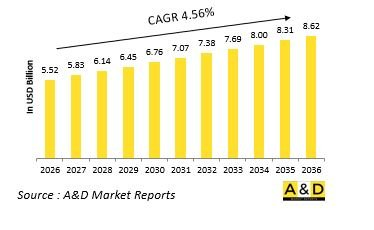
세계의 전투 잠수정 시장 규모는 2026년에 약 55억 2,000만 달러로 추정되고, 2036년까지 86억 2,000만 달러에 이를 것으로 예측되며, 2026-2036년의 예측 기간에 CAGR 4.56%의 성장이 전망됩니다.

세계 전투 잠수정 소개
전투 잠수정은 다양한 군사 작전을 지원하기 위해 설계된 특수 수중 플랫폼으로, 전쟁이 치열한 해양 환경에서 스텔스성, 기동성, 다재다능함을 제공합니다. 이 선박은 인원, 장비, 정찰 도구를 비밀리에 배치할 수 있으며, 부대가 감지되지 않고 특수 작전, 감시, 정보 수집 작전을 수행할 수 있게 해줍니다. 기존 잠수함과 달리 전투 잠수정은 일반적으로 더 작고 기동성이 뛰어나며, 얕은 수심이나 제한된 수역에서의 신속한 전개와 회수에 최적화되어 있습니다. 현대식 설계는 유체역학적 효율성, 소음 감소, 운영상의 신뢰성에 중점을 두어 다양한 조건에서 효과적인 항해를 보장합니다. 단독 운용 또는 대형 함정과의 연계 운용이 가능하며, 정밀한 병력투입, 특수부대 회수, 대 기뢰작전 및 대잠수함 작전 지원을 원활하게 수행합니다. 모듈식 구성으로 특수한 페이로드, 센서, 무인 시스템을 탑재할 수 있어 작전상의 유연성을 높였습니다. 영유권 분쟁, 비대칭적 위협, 신속 대응 능력의 필요성 등 해양 안보 과제가 복잡해짐에 따라 전투 잠수정의 전략적 가치는 더욱 높아지고 있습니다. 이러한 개발 투자는 스텔스성과 작전 안전성을 유지하면서 해군의 작전 범위를 확대하는 광범위한 추세를 반영하고 있습니다. 이러한 플랫폼은 전통적인 수상작전과 첨단 수중작전 사이의 간극을 메우는 현대 해전에서 필수적인 자산으로 인식되고 있습니다.
세계 전투 잠수정에 대한 기술의 영향
기술 발전은 전투 잠수정의 능력을 극적으로 변화시켜 작전 성능, 스텔스성, 작전 다양성을 향상시키고 있습니다. 전기 추진 및 하이브리드 구동 등 현대식 추진 시스템은 음향 특성을 감소시켜 적의 감지를 어렵게 합니다. 소나 매핑, 관성 유도, GPS 통합을 결합한 첨단 내비게이션 시스템은 복잡한 수중 환경에서 정밀한 기동을 가능하게 합니다. 다중 스펙트럼 감지, 이미징 소나, 환경 모니터링 기능을 갖춘 센서는 실시간 상황 인식을 제공하여 정확한 정찰과 위협 평가를 가능하게 합니다. 자동화와 AI는 적응형 항로 계획, 위협 회피, 작전 최적화를 촉진하고 작전 성공률을 향상시키며, 작전 요원들의 부담을 줄여줍니다. 모듈식 페이로드 설계를 통해 작전 요건에 따라 무인잠수정, 감시 장비 또는 특수 전투 시스템을 통합할 수 있습니다. 경량 복합재료와 내식성 합금과 같은 첨단 소재는 내구성을 향상시키고, 극한의 압력 및 온도 변화 하에서 성능을 향상시킵니다. 보안 통신 네트워크는 전자전 환경에서도 잠수함과 사령부 간의 안정적인 데이터 교환을 보장합니다. 사이버 보안 대책은 해킹 및 전자적 방해로부터 선박 제어 시스템을 보호합니다. 이러한 기술 혁신을 통해 전투 잠수정은 보다 높은 효율성과 유연성, 생존성을 가지고 운용할 수 있게 되었으며, 현대 해군 전략과 특수작전에서 매우 중요한 자산이 되었습니다.
전투 잠수정의 주요 추진 요인
세계적으로 전투 잠수정의 개발 및 배치를 촉진하는 여러 요인이 존재합니다. 정보 수집, 정찰, 특수부대 투입 등 비밀 해상 작전에 대한 수요가 증가하면서 스텔스 기능을 갖춘 수중 플랫폼에 대한 수요가 증가하고 있습니다. 연안 및 분쟁 해역에서의 지정학적 긴장과 지역 분쟁은 각국에 신속한 대응이 가능한 저시정성 자산을 통한 해상 역량 강화를 요구하고 있습니다. 추진 시스템, 센서 시스템, 재료, 자동화 기술의 발전은 더 빠르고, 더 조용하고, 더 다재다능한 선박의 개발을 뒷받침하고 있습니다. 현대의 해군 전략은 잠수함을 수상함대, 무인 플랫폼, 항공정찰과 통합한 다영역 작전을 중시하고, 연계 작전을 추진하고 있습니다. 전력 현대화 및 비대칭전 능력에 대한 예산 배분은 잠수 플랫폼에 대한 투자를 촉진하고 있습니다. 과거 분쟁에서의 작전 경험은 이 함정들이 상황 인식 향상, 정밀 작전 수행, 광범위한 해군 목표 지원에 효과적이라는 것을 입증했습니다. 파트너십, 국방 협력, 국내 제조 개념은 연구개발과 생산을 가속화하고 적시 조달을 보장합니다. 해적 행위, 영해 침범, 해저 인프라 보호와 같은 해양 안보 문제가 증가함에 따라 특수 잠수함 솔루션의 필요성이 더욱 커지고 있습니다. 이러한 요인으로 인해 전투 잠수정은 기술 혁신과 작전상의 필요를 결합하여 현대 해군 전략의 중요한 구성 요소로 자리매김하고 있습니다.
세계의 전투 잠수정 시장에 대해 조사 분석했으며, 시장에 영향을 미치는 기술, 향후 10년간의 예측, 각 지역별 동향 등의 정보를 전해드립니다.
지역별
유형별
추진 별
북미
성장 촉진요인, 억제요인, 과제
PEST
주요 기업
공급업체 Tier 상황
기업 벤치마킹
유럽
중동
아시아태평양
남미
미국
방위 프로그램
최신 뉴스
특허
이 시장에서의 현재 기술 성숙도
캐나다
이탈리아
프랑스
독일
네덜란드
벨기에
스페인
스웨덴
그리스
호주
남아프리카공화국
인도
중국
러시아
한국
일본
말레이시아
싱가포르
브라질
The Global Combat Submersible vehicles market is estimated at USD 5.52 billion in 2026, projected to grow to USD 8.62 billion by 2036 at a Compound Annual Growth Rate (CAGR) of 4.56% over the forecast period 2026-2036.
Introduction to Global Combat Submersible Vehicles
Combat submersible vehicles are specialized underwater platforms designed to support a range of military operations, providing stealth, mobility, and versatility in contested maritime environments. These vehicles enable covert deployment of personnel, equipment, and reconnaissance tools, allowing forces to conduct special operations, surveillance, and intelligence-gathering missions undetected. Unlike traditional submarines, combat submersibles are often smaller, more maneuverable, and optimized for rapid deployment and retrieval in shallow or restricted waters. Modern designs focus on hydrodynamic efficiency, noise reduction, and operational reliability, ensuring effective navigation under diverse conditions. They can operate independently or in coordination with larger naval vessels, facilitating precision insertions, extraction of special forces, and support for mine countermeasure or anti-submarine operations. With modular configurations, these vehicles can carry specialized payloads, sensors, or unmanned systems, enhancing mission flexibility. The increasing complexity of maritime security challenges, including territorial disputes, asymmetric threats, and the need for rapid response capabilities, has elevated the strategic value of combat submersibles. Investment in their development reflects a broader trend toward enhancing naval operational reach while maintaining stealth and operational security. These platforms are increasingly recognized as indispensable assets in modern naval warfare, bridging the gap between conventional surface operations and advanced underwater missions.
Technology Impact in Global Combat Submersible Vehicles
Technological advancements have dramatically transformed the capabilities of combat submersible vehicles, enhancing their operational performance, stealth, and mission versatility. Modern propulsion systems, including electric and hybrid drives, reduce acoustic signatures, making detection by adversaries more difficult. Advanced navigation systems, combining sonar mapping, inertial guidance, and GPS integration, allow precise maneuvering in complex underwater environments. Sensors equipped with multi-spectral detection, imaging sonar, and environmental monitoring provide real-time situational awareness, enabling accurate reconnaissance and threat assessment. Automation and artificial intelligence facilitate adaptive route planning, threat avoidance, and mission optimization, reducing operator workload and increasing mission success rates. Modular payload designs allow integration of unmanned underwater vehicles, surveillance equipment, or specialized combat systems depending on operational requirements. Advanced materials, such as lightweight composites and corrosion-resistant alloys, improve durability and enhance performance under extreme pressure and temperature variations. Secure communication networks ensure reliable data exchange between submersibles and command centers, even in contested electronic environments. Cybersecurity measures protect vehicle control systems from hacking or electronic interference. These technological innovations collectively enable combat submersible vehicles to operate with higher efficiency, flexibility, and survivability, making them crucial assets for modern naval strategies and special operations missions.
Key Drivers in Combat Submersible Vehicles
Several key factors drive the development and deployment of combat submersible vehicles globally. The increasing need for covert maritime operations, such as intelligence gathering, reconnaissance, and special forces insertions, creates demand for stealthy underwater platforms. Geopolitical tensions and regional disputes in coastal and contested waters compel nations to strengthen maritime capabilities with rapid-response, low-visibility assets. Technological progress in propulsion, sensor systems, materials, and automation supports the creation of vehicles that are faster, quieter, and more versatile. Modern naval strategies emphasize multi-domain operations, integrating submersible vehicles with surface fleets, unmanned platforms, and aerial reconnaissance for coordinated missions. Budget allocations toward force modernization and asymmetric warfare capabilities encourage investment in submersible platforms. Operational experience from past conflicts has demonstrated the effectiveness of these vehicles in enhancing situational awareness, conducting precision operations, and supporting broader naval objectives. Partnerships, defense collaborations, and domestic manufacturing initiatives accelerate research and production, ensuring timely acquisition. Increasing maritime security challenges, such as piracy, territorial incursions, and undersea infrastructure protection, further amplify the need for specialized submersible solutions. Collectively, these drivers establish combat submersible vehicles as critical components of modern naval doctrine, bridging technological innovation with operational necessity.
Regional Trends in Combat Submersible Vehicles
Regional trends in the deployment and development of combat submersible vehicles vary according to strategic priorities, security environments, and naval capabilities. North America focuses on highly advanced, long-endurance submersibles designed for special operations, deep reconnaissance, and integration with multi-domain networks. European nations prioritize interoperability, collaborative development programs, and modular platforms to balance capabilities with cost-effectiveness. In the Asia-Pacific region, rising maritime territorial disputes and the need for rapid coastal defense drive investment in domestically produced, versatile submersibles capable of operating in shallow waters and congested maritime zones. Middle Eastern countries emphasize tactical submersibles for surveillance, coastal protection, and special forces operations, often acquiring technology through partnerships or imports. African and South American nations focus on cost-efficient, operationally flexible designs to enhance maritime security without extensive investment in large naval fleets. Across regions, integration with unmanned underwater vehicles, advanced sensors, and real-time command networks is increasingly common. Regional exercises and joint operations support operational readiness while influencing vehicle design and capability requirements. Variations in strategic priorities, threat perception, and technological infrastructure shape the development of combat submersible vehicles worldwide, reflecting diverse operational needs while advancing stealth, mobility, and multi-role effectiveness.
Teledyne Technologies Incorporated announced that its Huntsville, Alabama-based subsidiary, Teledyne Brown Engineering, has been awarded a sole-source contract by the Naval Sea Systems Command for the follow-on production of MK11 Shallow Water Combat Submersible systems. Including all available options, the contract carries a total value of $178 million. The MK11 SWCS is a manned combat submersible designed to support the covert insertion and extraction of Special Operations Forces in high-threat environments. Under an earlier agreement with the U.S. Special Operations Command, Teledyne Brown Engineering successfully completed the design, manufacturing, testing, and delivery of the Engineering Development Model of the system. Following the successful completion of the EDM phase, USSOCOM exercised contract options authorizing the production and delivery of additional MK11 SWCS units.
By Region
By Type
By Propulsion
The 10-year combat submersible vehicles market analysis would give a detailed overview of missile and smart kits guidance market growth, changing dynamics, technology adoption overviews and the overall market attractiveness is covered in this chapter.
This segment covers the top 10 technologies that is expected to impact this market and the possible implications these technologies would have on the overall market.
The 10-year combat submersible vehicles market forecast of this market is covered in detailed across the segments which are mentioned above.
The regional combat submersible vehicles market trends, drivers, restraints and Challenges of this market, the Political, Economic, Social and Technology aspects are covered in this segment. The market forecast and scenario analysis across regions are also covered in detailed in this segment. The last part of the regional analysis includes profiling of the key companies, supplier landscape and company benchmarking. The current market size is estimated based on the normal scenario.
North America
Drivers, Restraints and Challenges
PEST
Key Companies
Supplier Tier Landscape
Company Benchmarking
Europe
Middle East
APAC
South America
This chapter deals with the key defense programs in this market, it also covers the latest news and patents which have been filed in this market. Country level 10 year market forecast and scenario analysis are also covered in this chapter.
US
Defense Programs
Latest News
Patents
Current levels of technology maturation in this market
Canada
Italy
France
Germany
Netherlands
Belgium
Spain
Sweden
Greece
Australia
South Africa
India
China
Russia
South Korea
Japan
Malaysia
Singapore
Brazil
The opportunity matrix helps the readers understand the high opportunity segments in this market.
Hear from our experts their opinion of the possible analysis for this market.