



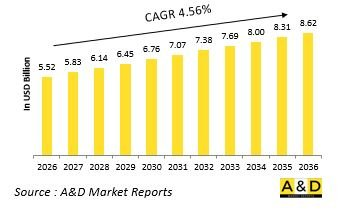
세계의 방위용 관성 측정 장치(IMU) 시장 규모는 2026년 55억 2,000만 달러로 평가되었고, 2026-2036년의 예측 기간 동안 CAGR 4.56%로 성장할 것으로 보이며, 2036년까지 86억 2,000만 달러에 이를 것으로 전망되고 있습니다.

세계의 방위용 관성 측정 장치(IMU) 시장은 GPS와 같은 외부 기준이 이용 불가능하거나 손상된 상황에서 군사 플랫폼에 자율 항법, 안정화 및 유도 기능을 제공하는 핵심 센서를 포괄합니다. IMU는 가속도계, 자이로스코프, 그리고 때로는 지구 자기장에 대한 선형 가속도, 각속도, 방향을 측정하는 자력계로 구성됩니다. 이러한 시스템은 잠수함 내 항법, 미사일 및 탄약 유도, 무기 체계 및 센서 안정화, 항공기 및 무인 차량 제어의 기반을 형성합니다. 군사 작전이 GPS 차단 환경(재밍, 스푸핑 또는 물리적 장애로 인한)에서 점점 더 많이 수행됨에 따라, 정밀하고 드리프트 없는 관성 항법의 중요성은 기하급수적으로 증가했습니다. IMU 기술은 포탄용 전술 등급 시스템부터 탄도 미사일 잠수함용 전략 등급 항법에 이르기까지, 임무 요구사항과 플랫폼 제약 조건에 정확히 부합하는 성능 특성을 갖추고 있습니다.
IMU의 기술적 진화는 성능 범주 전반에 걸친 소형화, 정확도 향상, 비용 절감에 중점을 두고 있습니다. 마이크로 전자 기계 시스템(MEMS) 기술은 전술 등급 IMU에 혁명을 일으켜 유도 탄약 및 소형 무인 시스템을 위한 소형, 경제적이고 견고한 센서의 대량 생산을 가능하게 했습니다. 광섬유 자이로스코프(FOG)와 링 레이저 자이로스코프(RLG)는 편향 안정성 향상과 크기 축소를 통해 전략급 및 항법급 응용 부문에서 지속적으로 발전하고 있습니다. 신흥 양자 기반 관성 센싱 기술은 기계적 운동 대신 원자 특성을 측정함으로써 정확도를 수십 배 향상시킬 전망입니다. 시스템 온 칩(SoC) 설계는 다양한 센서 유형과 처리 전자 장치를 통합하여 단일 패키지 내 완전한 관성 항법 솔루션을 구현합니다. 고급 보정 및 보상 알고리즘은 인공지능을 활용해 센서 오류를 실시간으로 모델링하고 교정합니다. 이러한 발전은 IMU 적용 범위를 확장하는 동시에 크기, 무게, 전력 제약이 있는 설치 환경에서의 성능을 향상시킵니다.
GPS 신호를 차단하거나 저하시키는 전자전 능력의 확산은 대체 항법 솔루션에 대한 근본적인 수요를 창출하며, 관성 시스템은 주요 GPS 백업 또는 대체 수단으로 기능합니다. 포탄부터 순항 미사일에 이르는 유도 무기 재고의 확장은 비행 전반에 걸쳐 충분한 정확도를 유지하는 대량 생산 가능하고 비용 효율적인 IMU를 요구합니다. 공중, 지상, 해상 영역에 걸친 자율 시스템 개발은 위치 고정 사이의 추정 항법(dead reckoning)을 위한 신뢰할 수 있는 관성 감지에 의존합니다. 이동 차량의 무기, 센서, 통신 장비에 대한 플랫폼 안정화 요구는 고대역폭 자세 측정 시스템 수요를 촉진합니다. 초음속 무기 개발은 극한의 진동 및 열 조건에서도 정밀도를 유지하며 안정적으로 작동하는 IMU 기술을 요구합니다. 또한 전략적 억제력 현대화는 잠수함 및 미사일 항법 정확도의 지속적인 개선을 필요로 하여, 비용과 무관하게 최고 성능 관성 시스템에 대한 수요를 지속시킵니다
지역별 IMU 역량은 자국 무기 개발 프로그램 및 전략적 자율성 목표와 밀접하게 연관됩니다. 북미는 모든 IMU 기술 범주에 걸쳐 포괄적인 역량을 유지하며, 특히 전략급 시스템과 MEMS 대량 생산에서 강점을 보입니다. 유럽의 개발은 다국적 협력을 통해 항공우주 응용 부문를 위한 고성능 FOG 및 RLG 시스템에 중점을 둡니다. 아시아태평양 지역은 중국, 일본, 한국이 MEMS부터 전략급에 이르는 완전한 자국산 IMU 생태계를 구축하며 급속한 발전을 보이고 있습니다. 이스라엘은 정밀유도탄용 전술급 IMU 부문에서 특화된 전문성을 확보했습니다. 러시아는 기계식 자이로 기술의 기존 강점을 유지하면서 현대식 고체식 대안을 개발 중입니다. 고성능 관성 기술에 대한 수출 통제는 전략적 무기 자율성을 추구하는 지역의 자체 개발을 촉진하는 장벽을 형성하지만, 상용 MEMS의 보급은 전 세계적으로 유능한 전술 시스템의 진입 장벽을 낮추었습니다.
파라스 디펜스 앤드 스페이스 테크놀로지스 리미티드(Paras Defence and Space Technologies Limited)는 2025년 10월 이스라엘의 시엘로 관성 솔루션스(Cielo Inertial Solutions)와 전략적 양해각서(MoU)를 체결하여 첨단 관성 측정 장치(IMU), 광섬유 자이로(FOG) 기반 센서 및 통합 항법 시스템을 공동 개발, 생산 및 마케팅하기로 합의했습니다. 이 협력은 GPS 차단 환경에서 정밀 관성 항법이 필요한 무인기, 미사일, 장갑차 등 인도 육군, 해군, 공군 및 DRDO 플랫폼을 대상으로 합니다. 계약은 ‘아트만니르바르 바랏(자립 인도)’ 목표에 부합하도록 70% 이상의 현지화를 위한 기술 이전을 강조합니다. 간접적 오프셋을 통해 가치를 창출하며, ideaForge 드론과 같은 고고도 작전을 지원합니다. 2026년 중반까지 파라스의 벵갈루루 시설에서 생산을 시작하며 우방국 수출을 목표로 합니다. 이는 사프란과 허니웰 수입에 의존하던 국내 IMU 공급의 핵심 공백을 메워 국경 감시 및 정밀 타격에서 전술적 우위를 강화합니다.
플랫폼별
지역별
최종 사용자별
이 장에서는 10년간 시장 전망에 대한 변화하는 추세, 기술 채택 개요 및 시장 매력에 대한 자세한 개요를 제공합니다.
이 부문에서는 이 시장에 영향을 미칠 것으로 예상되는 상위 10개 기술과 이러한 기술이 시장 전체에 미칠 수 있는 영향에 대해 설명합니다.
이 시장의 10년간 시장 예측은 위의 부문에 걸쳐 자세히 설명되어 있습니다.
이 부문은 지역별 시장 동향, 촉진요인, 억제요인, 과제, 정치, 경제, 사회, 기술 등의 측면을 다룹니다. 또한 지역별 시장 예측과 시나리오 분석도 자세히 다루고 있습니다. 지역 분석의 마지막 단계에서는 주요 기업 프로파일링, 공급업체의 상황, 기업 벤치 마크 등을 다룹니다.
북미
촉진요인, 억제요인, 과제
PEST
주요 기업
공급자 계층 구조 상태
기업 벤치마킹
유럽
중동
아시아태평양
남미
국가별 분석
이 장에서는 이 시장에서 주요 방위 프로그램을 다루며 이 시장에서 신청된 최신 뉴스와 특허에 대해서도 설명합니다. 또한 국가 수준의 10년간 시장 예측과 시나리오 분석에 대해서도 설명합니다.
미국
방위 프로그램
최신 뉴스
특허
이 시장의 현재 기술 성숙도
캐나다
이탈리아
프랑스
독일
네덜란드
벨기에
스페인
스웨덴
그리스
호주
남아프리카
인도
중국
러시아
한국
일본
말레이시아
싱가포르
브라질
기회 매트릭스
기회 매트릭스는 독자가 이 시장에서 기회의 높은 부문을 이해하는 데 도움이 됩니다.
전문가 의견
이 시장의 향후 전망에 대해 당사 전문가 의견을 정리했습니다.
The Global Defense Inertial Measurement Unit market is estimated at USD 5.52 billion in 2026, projected to grow to USD 8.62 billion by 2036 at a Compound Annual Growth Rate (CAGR) of 4.56% over the forecast period 2026-2036.
The Global Defense Inertial Measurement Unit (IMU) Market encompasses the critical sensors that provide autonomous navigation, stabilization, and guidance capabilities for military platforms when external references like GPS are unavailable or compromised. IMUs consist of accelerometers, gyroscopes, and sometimes magnetometers that measure linear acceleration, angular rotation, and orientation relative to the Earth's magnetic field. These systems form the foundation for navigation in submarines, guidance for missiles and munitions, stabilization for weapon systems and sensors, and control for aircraft and unmanned vehicles. As military operations increasingly occur in GPS-denied environments-whether due to jamming, spoofing, or physical obstruction-the importance of precise, drift-free inertial navigation has grown exponentially. IMU technology spans from tactical-grade systems for artillery shells to strategic-grade navigation for ballistic missile submarines, with performance characteristics precisely matched to mission requirements and platform constraints.
Technological evolution in IMUs centers on miniaturization, accuracy improvement, and cost reduction across performance categories. Micro-electromechanical systems (MEMS) technology has revolutionized tactical-grade IMUs, enabling mass production of small, affordable, rugged sensors for guided munitions and small unmanned systems. Fiber-optic gyroscopes (FOGs) and ring laser gyroscopes (RLGs) continue advancing in strategic and navigation-grade applications, with improved bias stability and reduced size. Emerging quantum-based inertial sensing promises orders-of-magnitude improvement in accuracy by measuring atomic properties rather than mechanical motion. System-on-chip designs integrate multiple sensor types with processing electronics to create complete inertial navigation solutions in single packages. Advanced calibration and compensation algorithms use artificial intelligence to model and correct sensor errors in real time. These advancements expand IMU applications while improving performance in size, weight, and power constrained installations.
The proliferation of electronic warfare capabilities that can deny or degrade GPS signals creates fundamental demand for alternative navigation solutions, with inertial systems serving as the primary GPS backup or replacement. The expansion of guided munitions inventories-from artillery shells to cruise missiles-requires mass-producible, cost-effective IMUs that maintain sufficient accuracy throughout flight. Autonomous system development across air, ground, and maritime domains depends on reliable inertial sensing for dead reckoning between position fixes. Platform stabilization requirements for weapons, sensors, and communications equipment on moving vehicles drive demand for high-bandwidth attitude measurement systems. Hypersonic weapons development pushes IMU technology to operate reliably under extreme vibration and thermal conditions while maintaining precision. Additionally, modernization of strategic deterrent forces necessitates continuous improvement in submarine and missile navigation accuracy, sustaining demand for the highest performance inertial systems regardless of cost.
Regional IMU capabilities correlate closely with indigenous weapons development programs and strategic autonomy objectives. North America maintains comprehensive capability across all IMU technology categories, with particular strength in strategic-grade systems and MEMS mass production. European development emphasizes high-performance FOG and RLG systems for aerospace applications, often through multinational collaborations. The Asia-Pacific region shows rapid advancement, with China, Japan, and South Korea developing complete indigenous IMU ecosystems from MEMS to strategic grade. Israel has cultivated specialized expertise in tactical-grade IMUs for precision munitions. Russia maintains legacy strength in mechanical gyro technology while developing modern solid-state alternatives. Export controls on high-performance inertial technology create barriers that encourage local development in regions seeking strategic weapons autonomy, though commercial MEMS availability has lowered barriers to capable tactical systems worldwide.
Paras Defence and Space Technologies Limited signed a strategic MoU in October 2025 with Israel's Cielo Inertial Solutions to co-develop, produce, and market advanced Inertial Measurement Units (IMUs), Fiber Optic Gyro (FOG)-based sensors, and integrated navigation systems. This partnership targets Indian Army, Navy, Air Force, and DRDO platforms, including UAVs, missiles, and armored vehicles requiring precise inertial navigation amid GPS-denied environments. The deal emphasizes technology transfer for 70%+ localization, aligning with Aatmanirbhar Bharat goals. Valued indirectly through offsets, it supports high-altitude ops like those in ideaForge drones. Production begins at Paras' Bengaluru facility by mid-2026, with exports eyed for friendly nations. This fills a critical gap in domestic IMU supply, previously reliant on imports from Safran and Honeywell, enhancing tactical edge in border surveillance and precision strikes.
By Platform
By Region
By End - User
The 10-year market outlook would give a detailed overview of changing dynamics, technology adoption overviews and the overall market attractiveness is covered in this chapter.
This segment covers the top 10 technologies that is expected to impact this market and the possible implications these technologies would have on the overall market.
The 10-year market forecast of this market is covered in detailed across the segments which are mentioned above.
The regional market trends, drivers, restraints and Challenges of this market, the Political, Economic, Social and Technology aspects are covered in this segment. The market forecast and scenario analysis across regions are also covered in detailed in this segment. The last part of the regional analysis includes profiling of the key companies, supplier landscape and company benchmarking.
North America
Drivers, Restraints and Challenges
PEST
Key Companies
Supplier Tier Landscape
Company Benchmarking
Europe
Middle East
APAC
South America
Country Analysis
This chapter deals with the key defense programs in this market, it also covers the latest news and patents which have been filed in this market. Country level 10 year market forecast and scenario analysis are also covered in this chapter.
US
Defense Programs
Latest News
Patents
Current levels of technology maturation in this market
Canada
Italy
France
Germany
Netherlands
Belgium
Spain
Sweden
Greece
Australia
South Africa
India
China
Russia
South Korea
Japan
Malaysia
Singapore
Brazil
Opportunity Matrix
The opportunity matrix helps the readers understand the high opportunity segments in this market.
Expert Opinions
Hear from our experts their opinion of the possible outlook for this market.