


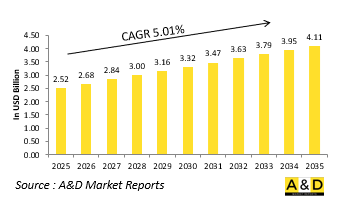
전 세계 9mm 시장 규모는 2025년에 약 25억 2,000만 달러로 추정되며, 2035년에는 41억 1,000만 달러에 달할 것으로 예상되며, 예측 기간인 2025-2035년 동안 5.01%의 CAGR로 성장할 것으로 예상됩니다.
기술의 발전은 현대 국방 상황에서 9mm 총기의 성능과 활용에 큰 영향을 미치고 있습니다. 야금학 및 제조 정밀도의 향상으로 이 구경의 총기는 내구성과 신뢰성이 향상되었습니다. 폴리머 및 합금 구조의 발전은 구조적 무결성을 유지하면서 경량화를 실현하여 기능성을 유지하면서 휴대성을 향상시켰습니다. 탄약의 경우, 추진제 화학적 특성과 탄환 설계의 발전으로 다양한 교전 범위에서 종결 성능, 관통력, 일관성이 향상되었습니다. 과거에는 특수부대에만 사용되던 중공탄과 배리어 블라인드 탄환도 이제는 더 일반적으로 배치되어 실전에서 그 효용성이 높아지고 있습니다. 강화된 광학 장비, 모듈식 부착물, 인체공학적 개선으로 9mm 플랫폼도 현대화되어 더 빠른 표적 전환, 스트레스 상황에서의 더 나은 제어, 야간 투시경 및 디지털 타겟팅 시스템과의 호환성이 가능해졌습니다. 레드닷 조준경 및 무기 장착 조명과 같은 스마트 액세서리는 특히 저조도 환경이나 도심 환경에서 작전 효율성을 향상시킵니다. 훈련에서는 시뮬레이션 기술을 통해 보다 효율적인 기술 개발이 가능해져 전투 태세를 유지하면서 실전에 대한 의존도를 낮출 수 있습니다. 이러한 모든 기술 혁신은 9mm 시스템의 전술적 유용성을 확대하는 데 기여하고, 고도로 역동적이고 기술 주도적인 방어 환경에서 9mm 시스템이 계속 유용하게 사용될 수 있도록 보장합니다. 그 결과, 기존의 작전 프로필과 새로운 작전 프로필을 모두 지원하는 보다 정교하고 능력 있고 적응력이 뛰어난 플랫폼이 탄생했습니다.
방어용 9mm의 지속적인 성공은 전술적 필요성, 운영 효율성, 경제적 실용성의 조합에 의해 이루어졌으며, 9mm가 사용되는 가장 설득력 있는 이유 중 하나는 특히 빠른 추격과 근접전에서 기동성이 필요한 시나리오에서 제지 능력과 기동성의 균형이 잘 잡혀 있기 때문입니다. 균형이 잘 잡혀 있다는 점입니다. 이 구경은 가볍기 때문에 대원들은 큰 부담 없이 더 많은 탄약을 휴대할 수 있습니다. 동맹군 전체의 표준화는 물류, 조달 및 훈련을 더욱 단순화하여 공동 작전에서 상호 운용성을 촉진합니다. 이러한 호환성은 탄약의 원활한 공유가 중요한 다국적 연합에 특히 중요합니다. 또한 9mm는 권총에서 소형 자동소총에 이르기까지 다양한 플랫폼에 적합하여 다양한 작전요구에 대응하고 전투와 지원 역할을 유연하게 수행할 수 있습니다. 또한, 9mm 무기와 탄약의 생산 비용이 상대적으로 낮기 때문에 신뢰할 수 있는 사이드암 솔루션을 원하는 대규모 방위군과 소규모 방위군 모두에서 9mm 무기가 인기를 끌고 있습니다. 비대칭 위협과 도시전 환경의 진화로 인해 소형, 고속, 근거리에서 효과적인 무기에 대한 요구가 계속 증가하고 있으며, 이는 9mm 플랫폼의 장점과 완벽하게 일치합니다. 군의 요구가 진화하더라도 9mm는 그 적응성으로 인해 실용적이고 전략적인 선택이 될 것입니다.
각 지역의 9mm 총기 사용 현황은 전략적 정책과 조달 능력을 모두 반영하고 있으며, 그 결과 국방 현장에서 다양한 채택 패턴을 볼 수 있습니다. 북미, 특히 미국에서는 탄도 개선과 경량화 및 대용량 사이드암으로의 전환으로 인해 9mm가 군과 법집행기관에서 다시 각광을 받고 있습니다. 유럽에서는 NATO의 표준화와 이 지역이 역사적으로 많은 주요 9mm 플랫폼을 개발했기 때문에 이 구경에 대한 오랜 선호도가 유지되고 있습니다. 유럽의 방위군은 정밀 엔지니어링과 상호 운용성을 우선시하는 경우가 많으며, 국군 및 다국적군이 9mm 권총과 기관단총을 장착하는 경우가 많습니다. 아시아태평양에서는 도시화의 진행과 국내 안보의 요구로 인해 헌병대, 특수부대, 국경수비대에 9mm 무기가 널리 채택되고 있습니다.
세계의 9mm 시장에 대해 조사 분석했으며, 성장 촉진요인, 향후 10년간의 전망, 지역별 동향 등의 정보를 전해드립니다.
9mm 시장 보고서의 정의
9mm 시장 세분화
지역별
유형별
용도별
재료별
향후 10년간 9mm 시장 분석
세계의 9mm 시장 예측
지역의 9mm 시장 동향과 예측
북미
촉진요인, 억제요인, 과제
PEST
주요 기업
공급업체 Tier 상황
기업 벤치마크
유럽
중동
아시아태평양
남미
미국
방위 프로그램
최신 뉴스
특허
이 시장의 현재 기술 성숙도
캐나다
이탈리아
프랑스
독일
네덜란드
벨기에
스페인
스웨덴
그리스
호주
남아프리카공화국
인도
중국
러시아
한국
일본
말레이시아
싱가포르
브라질
9mm 시장 기회 매트릭스
9mm 시장 보고서에 관한 전문가의 의견
The Global 9mm Market is estimated at USD 2.52 billion in 2025, projected to grow to USD 4.11 billion by 2035 at a Compound Annual Growth Rate (CAGR) of 5.01% over the forecast period 2025-2035.
The 9mm cartridge holds a central position in global defense arsenals due to its balance of performance, versatility, and logistical practicality. Widely used in handguns and submachine guns, the 9mm round is favored for its manageable recoil, adequate stopping power, and high magazine capacity, making it suitable for military, law enforcement, and security operations. Its widespread adoption is a result of decades of standardization efforts that sought a reliable and universally accessible sidearm solution. Armed forces around the world continue to rely on 9mm platforms for close-quarters engagements, personal defense, and tactical roles. The compact size and ease of handling allow for fast target acquisition, particularly in confined spaces where larger calibers may prove unwieldy. This caliber is also compatible with a variety of modern weapons, from service pistols to compact automatic firearms, enhancing its utility across diverse operational contexts. Military units benefit from the logistical simplicity of a widely supported round, with manufacturers across continents producing compatible ammunition and components. The 9mm's sustained relevance underscores its adaptability in changing combat environments and evolving military doctrines. It remains a key component in the broader ecosystem of defense firearms, valued for its efficiency, reliability, and cross-platform compatibility.
Technological advancements have significantly influenced the performance and application of 9mm firearms in modern defense contexts. Improvements in metallurgy and manufacturing precision have enhanced the durability and reliability of weapons chambered in this caliber. Advancements in polymer and alloy construction have reduced weight while maintaining structural integrity, making weapons easier to carry without compromising functionality. On the ammunition side, developments in propellant chemistry and bullet design have improved terminal performance, penetration, and consistency across various engagement ranges. Hollow-point and barrier-blind projectiles, once limited to special units, are now more commonly deployed, offering increased effectiveness in real-world combat conditions. Enhanced optics, modular attachments, and ergonomic improvements have also modernized 9mm platforms, enabling faster target transitions, better control under stress, and compatibility with night vision and digital targeting systems. Smart accessories, such as red dot sights and weapon-mounted lights, increase operational effectiveness, especially in low-light and urban environments. In training, simulation technologies have allowed more efficient skill development, reducing live-fire dependency while maintaining combat readiness. All these innovations contribute to extending the tactical utility of 9mm systems, ensuring they remain relevant in highly dynamic and technology-driven defense environments. The result is a more refined, capable, and adaptable platform that supports both traditional and emerging mission profiles.
The sustained prominence of 9mm in defense applications is driven by a combination of tactical necessity, operational efficiency, and economic practicality. One of the most compelling reasons for its use is the balance between stopping capability and controllability, especially in scenarios requiring rapid follow-up shots or close-quarters maneuverability. The caliber's lightweight nature allows personnel to carry more ammunition without adding significant burden, an advantage in extended or mobile operations. Standardization across allied forces further simplifies logistics, procurement, and training, promoting interoperability in joint missions. This compatibility is particularly valuable for multinational coalitions where seamless ammunition sharing can be critical. The 9mm's broad platform compatibility-from concealed handguns to compact automatic weapons-also supports varied mission demands, offering flexibility across combat and support roles. Additionally, the relatively low production cost of 9mm weapons and ammunition contributes to its popularity among both large and smaller defense forces seeking reliable sidearm solutions. The evolution of asymmetric threats and urban warfare environments continues to increase the need for weapons that are compact, fast, and effective at short ranges, which aligns perfectly with the strengths of the 9mm platform. As military needs evolve, its adaptability ensures that the 9mm remains a practical and strategic choice.
Regional use of 9mm firearms reflects both strategic doctrines and procurement capabilities, resulting in diverse adoption patterns across the defense landscape. In North America, especially the United States, the 9mm has regained prominence in military and law enforcement circles due to improved ballistics and the shift toward lighter, higher-capacity sidearms. Europe maintains a long-standing preference for this caliber, driven by NATO standardization and the region's historical development of many leading 9mm platforms. European defense forces often prioritize precision engineering and interoperability, with national and multinational units frequently equipping their personnel with 9mm handguns and submachine guns. In the Asia-Pacific region, increasing urbanization and internal security demands have led to broad integration of 9mm weapons for military police, special forces, and border units. Middle Eastern and North African nations tend to source 9mm platforms from both Western and Eastern suppliers, using them across a spectrum of conventional and paramilitary roles. In Latin America, 9mm firearms are widely used in defense and public security, often favored for their cost-effectiveness and ease of use in close-range operations. African nations are adopting 9mm systems at a growing pace, particularly in peacekeeping and counterinsurgency roles, where simple, durable sidearms are essential. This global footprint underscores the caliber's continued strategic relevance.
Carl Walther is supplying the Bundeswehr special forces with the new P14 and P14K service pistols, both derived from the successful PPD series of polymer-framed, striker-fired handguns. Meanwhile, attention is shifting to the upcoming P13 service pistol, which is intended to replace the P8-Heckler & Koch's sidearm that has served the German military for roughly 30 years. The procurement process for the new standard-issue service pistol, referred to as the P13 in official terms, is moving into its next phase. According to reports, only three of the original six competing manufacturers remain in the running for the contract, signaling a narrowing field in the competition to supply the next-generation sidearm to regular Bundeswehr forces.
9mm market Report Definition
9mm market Segmentation
By Region
By Type
By application
By Material
9mm market Analysis for next 10 Years
The 10-year 9mm market analysis would give a detailed overview of 9mm market growth, changing dynamics, technology adoption overviews and the overall market attractiveness is covered in this chapter.
This segment covers the top 10 technologies that is expected to impact this market and the possible implications these technologies would have on the overall market.
Global 9mm market Forecast
The 10-year 9mm market forecast of this market is covered in detailed across the segments which are mentioned above.
Regional 9mm market Trends & Forecast
The regional 9mm market trends, drivers, restraints and Challenges of this market, the Political, Economic, Social and Technology aspects are covered in this segment. The market forecast and scenario analysis across regions are also covered in detailed in this segment. The last part of the regional analysis includes profiling of the key companies, supplier landscape and company benchmarking. The current market size is estimated based on the normal scenario.
North America
Drivers, Restraints and Challenges
PEST
Key Companies
Supplier Tier Landscape
Company Benchmarking
Europe
Middle East
APAC
South America
This chapter deals with the key defense programs in this market, it also covers the latest news and patents which have been filed in this market. Country level 10 year market forecast and scenario analysis are also covered in this chapter.
US
Defense Programs
Latest News
Patents
Current levels of technology maturation in this market
Canada
Italy
France
Germany
Netherlands
Belgium
Spain
Sweden
Greece
Australia
South Africa
India
China
Russia
South Korea
Japan
Malaysia
Singapore
Brazil
Opportunity Matrix for 9mm market
The opportunity matrix helps the readers understand the high opportunity segments in this market.
Expert Opinions on 9mm market Report
Hear from our experts their opinion of the possible analysis for this market.