


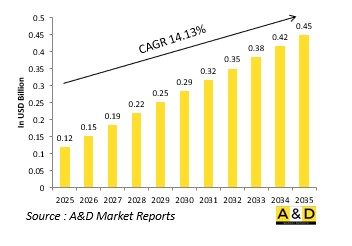
세계 경계 스캔 테스트 시스템 시장 규모는 2025년에 약 1억 2,000만 달러로 추정되며 2035년에는 4억 5,000만 달러에 달할 것으로 예상되며, 2025-2035년의 예측 기간 동안 연평균 14.13%의 연평균 복합 성장률(CAGR)을 보일 것으로 예측됩니다.
세계 군용 경계 스캔 테스트 시스템은 모든 부품에 물리적으로 접근하지 않고도 복잡한 전자 어셈블리의 구조적 무결성 및 기능성을 검증하는 데 사용되는 중요한 도구로, IEEE 1149.1 표준에 기반한 경계 스캔 기술은 집적 회로 내에 내장된 스캔 경로를 사용하여 상호 연결, 논리 소자, 메모리 소자의 테스트를 가능하게 합니다. 이 접근 방식은 고밀도 기판이나 다층 시스템이 캡슐화되어 있거나 기존의 프로브 기반 접근이 제한되는 열악한 환경에 배치되는 군용 전자 장비에 특히 유용합니다. 바운더리 스캔 시스템은 제조, 통합 및 현장 유지보수 단계에서 효율적인 고장 감지 및 진단을 촉진하여 시스템의 신뢰성과 수명주기 성능을 향상시킵니다. 비침습적 특성으로 인해 미사일 시스템, 레이더 유닛, 항공 전자 모듈, 보안 통신 장비 등 재가공 및 분해가 현실적이지 않거나 손상을 입힐 수 있는 최신 방어 플랫폼에 적합합니다. 전술 및 전략 시스템의 전자적 복잡성이 증가함에 따라 경계 스캔 테스트는 성능 보증의 중요한 수단이 되고 있습니다. 이 기술은 개별 테스트뿐만 아니라 임베디드 테스트 전략을 지원하여 예측 유지 보수 및 작전 대응에 기여합니다. 전 세계 방산 공급망에서 채택이 확대되고 있는 경계 스캔 시스템은 군용 전자 장비의 품질 관리 및 운영 보증 수준을 높이는 역할을 하고 있습니다.
기술의 발전으로 군용 경계 스캔 테스트 시스템의 기능과 용도가 크게 확대되어 최신 국방 전자 장비에 필수적인 첨단 진단 도구로 탈바꿈했습니다. 스캔 체인 관리, 패턴 생성 및 고장 분리 알고리즘을 강화하여 고집적 시스템온칩(SoC) 및 FPGA(Field Programmable Gate Array) 기반 설계에서도 진단의 정확도와 속도를 향상시켰습니다. 바운더리 스캔 시스템은 지속적인 상태 모니터링을 지원하고 외부 테스트 환경의 필요성을 줄이기 위해 자동 테스트 장비에 통합되거나 임베디드 테스트 기능으로 시스템 내에 내장되는 경우가 증가하고 있습니다. 바운더리 스캔과 인서킷 테스트 및 기능 테스트와 같은 다른 테스트 프로토콜을 결합하여 물리적 침입을 최소화하면서 종합적인 진단을 제공하는 하이브리드 솔루션이 탄생하고 있습니다. 최신 바운더리 스캔 툴은 현재 GUI와 API를 통한 자동화를 제공하며, 엔지니어와 기술자 모두가 접근할 수 있도록 지원하고 있습니다. 시스템 온 모듈(SoM) 테스트의 발전으로 최소한의 하드웨어 추가만으로 전체 서브시스템을 커버하는 경계 스캔이 가능해졌습니다. 또한, 사이버 보안 프레임워크와의 통합을 통해 안전한 인증된 테스트 방법이 가능해져 민감한 군사 환경에서 데이터의 무결성을 보호할 수 있습니다. 이러한 기술적 진보를 통해 바운더리 스캔은 제조에 특화된 프로세스에서 국방 전자 장비의 장기적인 신뢰성과 운영 효율성을 달성하기 위한 전략적 수단으로 발전하고 있습니다.
군용 전자 장비에서 경계 스캔 테스트 시스템의 채택이 증가하는 것은 여러 가지 요인에 기인합니다. 전자 부품의 소형화 및 복잡화, 인쇄 회로 기판의 고밀도화 및 다층화에 따라 기존의 액세스 기반 테스트는 더 이상 효과적이지 않거나 전혀 실용적이지 않게 되었습니다. 바운더리 스캔 기술은 임베디드 부품에 대한 비침습적 접근을 가능하게 함으로써 이러한 문제를 해결하고 최신 방위용 일렉트로닉스의 테스트에 필수적인 요소로 자리 잡았습니다. 평균복구시간(MTTR)을 단축하고 작전 대응성을 보장하기 위해 보다 빠르고 정확한 진단에 대한 요구도 중요한 촉진제 역할을 하고 있습니다.
세계의 경계 스캔 테스트 시스템(Boundary Scan Test System) 시장에 대해 조사 분석했으며, 성장 촉진요인, 향후 10년간 시장 전망, 각 지역별 동향 등의 정보를 전해드립니다.
지역별
컴포넌트별
기술별
용도별
북미
성장 촉진요인, 억제요인, 과제
PEST
주요 기업
공급업체 Tier 상황
기업 벤치마킹
유럽
중동
아시아태평양
남미
미국
방위 프로그램
최신 뉴스
특허
캐나다
이탈리아
프랑스
독일
네덜란드
벨기에
스페인
스웨덴
그리스
호주
남아프리카공화국
인도
중국
러시아
한국
일본
말레이시아
싱가포르
브라질
The Global Boundary Scan Test Systems market is estimated at USD 0.12 billion in 2025, projected to grow to USD 0.45 billion by 2035 at a Compound Annual Growth Rate (CAGR) of 14.13% over the forecast period 2025-2035.

Global military boundary scan test systems are critical tools used in verifying the structural integrity and functionality of complex electronic assemblies without requiring physical access to every component. Based on the IEEE 1149.1 standard, boundary scan technology enables testing of interconnections, logic devices, and memory elements by using built-in scan paths within integrated circuits. This approach is especially valuable in military electronics, where high-density boards and multi-layered systems are often encapsulated or deployed in rugged environments that limit traditional probe-based access. Boundary scan systems facilitate efficient fault detection and diagnostics during manufacturing, integration, and field maintenance stages, improving system reliability and lifecycle performance. Their non-invasive nature is well-suited for modern defense platforms, including missile systems, radar units, avionics modules, and secure communication equipment, where rework or teardown can be impractical or damaging. As electronic complexity grows within tactical and strategic systems, boundary scan testing becomes a key enabler of performance assurance. The technology supports not only standalone tests but also embedded test strategies, contributing to predictive maintenance and mission readiness. Increasing adoption across global defense supply chains highlights the role of boundary scan systems in elevating the standard of quality control and operational assurance in military electronics.
Technological progress has significantly expanded the capabilities and applications of military boundary scan test systems, transforming them into advanced diagnostic tools essential for modern defense electronics. Enhancements in scan chain management, pattern generation, and fault isolation algorithms have improved the accuracy and speed of diagnostics, even in highly integrated system-on-chip (SoC) and field-programmable gate array (FPGA)-based designs. Boundary scan systems are increasingly being integrated into automated test equipment and embedded within systems as built-in test capabilities, supporting continuous health monitoring and reducing the need for external test setups. The combination of boundary scan with other test protocols-such as in-circuit testing and functional testing-has created hybrid solutions that offer comprehensive diagnostics with minimal physical intrusion. Modern boundary scan tools now offer graphical user interfaces and API-driven automation, making them accessible to both engineers and technicians. Advances in system-on-module (SoM) testing have enabled boundary scan coverage across subsystems with minimal additional hardware. Furthermore, integration with cybersecurity frameworks allows secure, authenticated test procedures, safeguarding data integrity in sensitive military environments. These technological strides have elevated boundary scan from a manufacturing-focused process to a strategic enabler of long-term reliability and operational efficiency in defense electronics.
Several key factors are propelling the increasing adoption of boundary scan test systems in military electronics. The miniaturization and increased complexity of electronic components, coupled with the shift toward densely populated, multi-layer printed circuit boards, make traditional access-based testing less effective or entirely impractical. Boundary scan technology addresses this challenge by enabling non-intrusive access to embedded components, making it indispensable for testing modern defense electronics. The need for faster, more accurate diagnostics to reduce mean time to repair (MTTR) and ensure mission readiness is also a significant driver. As military systems become more interconnected and software-defined, early and precise detection of interconnect faults is essential to prevent cascading failures. Additionally, the defense sector's push toward embedded diagnostics and condition-based maintenance aligns well with boundary scan's capability to support built-in self-test and continuous monitoring features. Increasing global standards compliance and lifecycle cost reduction goals further encourage investment in boundary scan infrastructure. Finally, the demand for high-reliability electronics in mission-critical applications, such as avionics, unmanned systems, and secure communications, underscores the importance of adopting test methods that provide comprehensive fault coverage without physical intrusion or system disassembly.
Regional trends in military boundary scan test systems reflect the global nature of defense electronics manufacturing and the push for increased testing sophistication. In North America, particularly the United States, boundary scan is widely utilized in aerospace and defense sectors to support high-reliability standards in embedded systems, avionics, and command-control platforms. Its integration into automated test equipment used by prime contractors and tier-one suppliers reflects a mature ecosystem focused on lifecycle assurance and rapid diagnostics. In Europe, defense organizations are adopting boundary scan as part of broader digitalization and modular open systems approaches, emphasizing interoperability and in-field supportability across multinational programs. The Asia-Pacific region is experiencing strong growth, driven by indigenous platform development in countries such as China, India, South Korea, and Japan. These nations are incorporating boundary scan into their production and maintenance workflows to improve yield rates, lower defect risks, and reduce dependency on traditional test methods. In the Middle East, the deployment of modern electronics in new air defense and communications systems is increasing the need for reliable, automated test solutions that boundary scan technology offers. Latin America and Africa, while slower in adoption, are gradually integrating boundary scan into local defense manufacturing as part of modernization efforts and collaborative programs with global defense technology providers.
The European Commission has announced €60 million in funding for the Common Armoured Vehicle System (CAVS) project under the EDIRPA program (European Defense Industry Reinforcement Instrument through Joint Procurement). This ambitious initiative seeks to develop a modern, standardized armored vehicle to strengthen the operational capabilities of the armed forces in Finland, Latvia, Sweden, and Germany. The CAVS project aims to meet increasing demands for troop mobility and protection, while promoting defense collaboration and equipment standardization among European nations.
By Region
By Component
By Technology
By Application
The 10-year Global Aerospace and Defense Boundary Scan Test Systems market analysis would give a detailed overview of Global Aerospace and Defense Boundary Scan Test Systems market growth, changing dynamics, technology adoption overviews and the overall market attractiveness is covered in this chapter.
This segment covers the top 10 technologies that is expected to impact this market and the possible implications these technologies would have on the overall market.
The 10-year Global Aerospace and Defense Boundary Scan Test Systems market forecast of this market is covered in detailed across the segments which are mentioned above.
The regional Global Aerospace and Defense Boundary Scan Test Systems market trends, drivers, restraints and Challenges of this market, the Political, Economic, Social and Technology aspects are covered in this segment. The market forecast and scenario analysis across regions are also covered in detailed in this segment. The last part of the regional analysis includes profiling of the key companies, supplier landscape and company benchmarking. The current market size is estimated based on the normal scenario.
North America
Drivers, Restraints and Challenges
PEST
Key Companies
Supplier Tier Landscape
Company Benchmarking
Europe
Middle East
APAC
South America
This chapter deals with the key defense programs in this market, it also covers the latest news and patents which have been filed in this market. Country level 10 year market forecast and scenario analysis are also covered in this chapter.
US
Defense Programs
Latest News
Patents
Current levels of technology maturation in this market
Canada
Italy
France
Germany
Netherlands
Belgium
Spain
Sweden
Greece
Australia
South Africa
India
China
Russia
South Korea
Japan
Malaysia
Singapore
Brazil
The opportunity matrix helps the readers understand the high opportunity segments in this market.
Hear from our experts their opinion of the possible analysis for this market.