


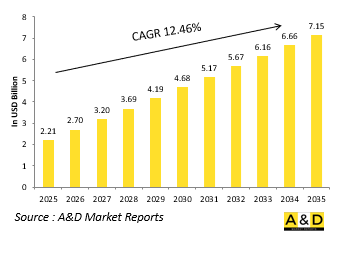
세계의 카운트다운 시험 시스템 시장 규모는 2025년 22억 1,000만 달러에서 예측 기간 중 12.46%의 CAGR로 추이하며, 2035년에는 71억 5,000만 달러로 성장할 것으로 예측됩니다.
카운트다운 시험 시스템 시장 : 소개
카운트다운 시험 시스템은 특히 미사일 발사 플랫폼, 우주 시스템, 복합 탄약과 같은 방어 시스템의 즉각적인 대응성과 신뢰성을 보장하는 데 중요한 역할을 합니다. 이러한 시스템은 발사 시퀀싱의 마지막 단계를 시뮬레이션하고 모니터링하도록 설계되었으며, 연료 보급, 유도 시스템 시작, 통신 링크 등 모든 동작을 현실적인 조건에서 검증하고 테스트해야 합니다. 카운트다운 단계는 모든 하위 시스템의 통합을 테스트하고 실제 배치 전에 모든 구성 요소가 제대로 작동하는지 확인하므로 매우 중요합니다. 카운트다운 시험 시스템은 점화에서 발사까지의 각 단계가 고장 없이 진행되도록 보장합니다. 이러한 시스템은 미사일 시스템, 우주 로켓 및 기타 군용 무기의 작동 상태를 확인하는 데 사용됩니다. 또한 문제 해결 및 시험 후 분석에 귀중한 실시간 데이터를 제공합니다. 카운트다운 시험 시스템에는 차량 및 플랫폼과의 적절한 통신, 센서 데이터 모니터링, 전체 시스템의 안전 메커니즘 관리를 보장하는 일련의 프로토콜이 포함되어 있습니다. 방위 활동의 높은 위험성을 고려할 때, 이러한 테스트는 임무의 성공과 운영 효율성을 보장하는 데 필수적입니다. 방위 기술의 범위가 계속 발전함에 따라 카운트다운 테스트는 더욱 정밀한 제어 및 데이터 분석을 통합하여 더욱 정교하게 발전하고 있습니다.
국방 분야에서의 첨단 카운트다운 시험 시스템의 도입과 확대에는 몇 가지 주요 요인이 영향을 미치고 있습니다. 가장 두드러진 요인 중 하나는 현대 국방 시스템의 복잡성입니다. 미사일, 로켓 및 기타 발사 플랫폼이 고도화됨에 따라 카운트다운 시퀀싱도 복잡해져 여러 시스템이 완벽하게 동기화되어 작동해야 합니다. 첨단 카운트다운 시험 시스템은 추진계, 유도장비, 통신계 등 각 서브시스템이 안정적으로 작동하고 발사시 결함이 발생하지 않도록 보장합니다. 이러한 복잡성에 대응하기 위해 테스트 시스템은 보다 유연하고 다양한 시나리오에 대응할 수 있어야 하며, 다수의 파라미터를 동시에 추적할 수 있는 능력이 요구됩니다. 또 다른 중요한 요소는 국방 프로그램의 운영 효율성 향상에 대한 요구입니다. 국방 조직은 항상 비용 절감과 성능 향상을 동시에 추구하고 있으며, 카운트다운 시험 시스템은 이를 달성하는 데 필수적인 요소입니다. 이러한 시스템은 결함을 조기에 발견하여 비용과 시간이 많이 소요되는 재시도를 줄일 수 있습니다. 테스트 단계에서 실시간 데이터를 제공함으로써 엔지니어는 설계를 최적화하고, 본격 가동 전에 문제를 수정할 수 있으며, 개발 기간을 단축하고 비용을 절감할 수 있습니다.
또한 신속하고 신뢰할 수 있는 발사 능력에 대한 수요도 카운트다운 시험 시스템의 고도화를 촉진하는 중요한 요소입니다. 현대의 국방 작전은 미사일, 로켓, 무인 시스템의 즉각적인 배치와 유연한 운용을 요구하고 있으며, 시험 시스템이 실시간 조건에서 모든 시스템이 완벽하게 작동하고 검증되었는지 확인하는 것이 필수적입니다. 이를 통해 발사 실패 위험을 줄이고 신뢰성을 확보할 수 있습니다. 또한 안전에 대한 고려도 큰 원동력입니다. 미사일이나 로켓과 같은 발사 시스템이 임무 수행 능력을 저해할 수 있는 결함이 없는지 확인하는 것은 매우 중요합니다. 카운트다운 시험 시스템은 연료 주입부터 시스템 진단, 최종 발사 단계에 이르기까지 전 과정에서 종합적인 점검을 통해 이러한 리스크를 파악하는 데 기여합니다. 마지막으로 극초음속 무기 및 우주 관련 플랫폼과 같은 차세대 기술을 국방 시스템에 통합하는 것도 첨단 카운트다운 시험 시스템이 필요한 이유 중 하나입니다. 이러한 기술들은 전례 없는 속도와 환경 조건에 노출되므로 이에 대응할 수 있는 시험 체계가 필수적입니다. 국방 기술이 앞으로 더욱 발전함에 따라 이에 대응하기 위한 보다 고도화되고 적응성이 높은 카운트다운 테스트 솔루션의 필요성이 점점 더 명확해지고 있습니다.
세계의 카운트다운 시험 시스템의 시장을 조사했으며, 시장의 현황, 기술 동향, 시장 영향요인의 분석, 시장 규모 추이·예측, 지역별 상세 분석, 경쟁 구도, 주요 기업의 개요 등을 정리하여 전해드립니다.
지역별
기술별
유형별
용도별
북미
촉진요인, 제약, 과제
억제요인
주요 기업
공급업체 Tier의 상황
기업 벤치마킹
유럽
중동
아시아태평양
남미
미국
방위 프로그램
최신 뉴스
특허
현재 기술 성숙도
캐나다
이탈리아
프랑스
독일
네덜란드
벨기에
스페인
스웨덴
그리스
호주
남아프리카공화국
인도
중국
러시아
한국
일본
말레이시아
싱가포르
브라질
The Global Count Down Test Systems market is estimated at USD 2.21 billion in 2025, projected to grow to USD 7.15 billion by 2035 at a Compound Annual Growth Rate (CAGR) of 12.46% over the forecast period 2025-2035.
Introduction to Count Down Test Systems Market
Count down test systems play a crucial role in ensuring the readiness and reliability of defense systems, particularly in the context of missile launch platforms, space systems, and complex munitions. These systems are designed to simulate and monitor the final stages of a launch sequence, where every action, such as fueling, activation of guidance systems, and communication links, needs to be verified and tested under realistic conditions. The countdown phase is critical because it tests the integration of all subsystems and verifies that all components are functioning correctly before actual deployment. A countdown test system ensures that each step in the sequence, from ignition to launch, progresses without failure. These systems are used to verify the operational status of missile systems, space launch vehicles, and other military-grade munitions. They also provide valuable real-time data for troubleshooting and post-test analysis. The countdown test systems involve a series of protocols that ensure proper communication with the vehicle or platform, monitoring sensor data, and managing the safety mechanisms of the entire system. Given the high stakes in defense operations, these tests are vital to ensure mission success and operational efficiency. As the scope of defense technologies continues to evolve, so too does the sophistication of countdown testing, incorporating more precise control and data analytics.
Technological advancements have significantly impacted defense countdown test systems, making them more precise, automated, and data-driven. One of the key developments is the integration of real-time telemetry systems into countdown procedures. Telemetry systems collect, transmit, and analyze critical data from test articles, such as missile systems or space vehicles, enabling operators to monitor the test from start to finish. These systems are now more sophisticated than ever, offering a broader range of sensors, including pressure, temperature, velocity, and vibration measurements, providing valuable insights into each phase of the countdown. The rise of digital twin technologies has also revolutionized countdown testing. With digital twins, engineers can simulate the entire countdown sequence, from ignition to final launch, in a virtual environment. This allows for better prediction of system behaviors under a variety of conditions and helps identify potential failure points before live tests occur. Another notable impact of technology is the introduction of automated test systems. These systems can carry out the countdown and execute numerous checks and validations without the need for direct human intervention, significantly reducing the potential for error. Automated systems improve the speed of testing, allowing for faster iterations and more comprehensive analysis of the test results. They also enable advanced predictive analytics, which can anticipate failures based on real-time data, thus providing the opportunity for early interventions. The integration of artificial intelligence (AI) and machine learning (ML) has made it possible to automatically adjust countdown parameters based on feedback from the test system. These AI-driven solutions are capable of identifying anomalies in data sets that would otherwise be missed, ensuring that any deviations from expected performance are captured and analyzed.
Moreover, the growth of cloud-based solutions has facilitated the storage and analysis of vast amounts of test data. Test operators and engineers can now access and share data across multiple locations, making collaboration easier and more efficient. This has streamlined the post-test analysis process, enabling faster decision-making and quicker revisions to systems or test setups. Modular and scalable test equipment is also becoming increasingly popular, allowing defense agencies and contractors to tailor countdown test systems to specific requirements while keeping costs down. Overall, technology has made countdown test systems more flexible, faster, and more reliable, enhancing the overall quality of defense product testing.
Several key drivers are influencing the growth and adoption of advanced countdown test systems in the defense sector. One of the most prominent drivers is the increasing complexity of modern defense systems. As missiles, rockets, and other launch platforms become more sophisticated, their countdown sequences become more intricate, involving multiple systems that must be synchronized perfectly. Advanced countdown test systems ensure that each subsystem-such as propulsion, guidance, and communication-functions properly and that there are no failures during the launch phase. This complexity requires test systems to be more dynamic, capable of handling different scenarios, and able to track a wide range of parameters simultaneously. Another key driver is the demand for higher operational efficiency in defense programs. Defense organizations are under constant pressure to reduce costs while improving performance. Countdown test systems are essential for achieving these goals, as they help to detect issues early in the process, reducing the need for costly and time-consuming rework. By providing real-time data during the test phase, these systems enable engineers to optimize designs and correct problems before systems go live. This not only saves money but also shortens the development cycle, allowing for faster deployment of operational defense systems.
The push for more reliable and rapid-launch military platforms also plays a significant role in driving advancements in countdown test systems. Modern defense operations demand rapid deployment and flexibility, with missiles, rockets, and unmanned systems needing to be launched quickly and reliably. Countdown test systems ensure that all systems are fully operational and validated under the stress of real-time conditions, providing confidence that launches will proceed without failure. Furthermore, safety concerns are a major driver, as defense systems must be rigorously tested to minimize risks. Ensuring that launch systems, whether they are missiles or rockets, are free of defects that could compromise their mission success is essential. Countdown test systems help identify such risks by offering comprehensive checks at every stage of the countdown, from fueling and system diagnostics to final launch. Finally, the integration of next-generation technologies into defense systems, such as hypersonic weapons and space-based platforms, requires equally advanced countdown test systems. These systems must be able to handle the unprecedented speeds and environmental conditions associated with these cutting-edge technologies. As defense technologies continue to evolve, there is a clear need for more advanced and adaptable countdown testing solutions to keep pace with new capabilities.
The global landscape for defense countdown test systems varies based on regional priorities, defense needs, and technological capabilities. In North America, particularly in the United States, the demand for advanced countdown testing is driven by the Department of Defense's (DoD) continued focus on missile defense systems, space exploration, and rapid deployment capabilities. Leading defense contractors in the U.S. are investing heavily in automated and high-fidelity countdown test systems that can handle the complexity of intercontinental ballistic missile (ICBM) and hypersonic weapon systems. U.S. companies like Lockheed Martin, Northrop Grumman, and Raytheon are at the forefront of these innovations, contributing to a highly sophisticated test environment.
In Europe, countries such as France, Germany, and the UK are also advancing their defense countdown test capabilities, particularly in the areas of space launch vehicles and ballistic missile defense. The European Space Agency (ESA) and NATO are investing in state-of-the-art test systems that ensure the reliability and readiness of their missile and rocket platforms. Collaborative efforts between European defense agencies and private defense contractors have led to an increasingly integrated testing environment, fostering innovation in countdown procedures.
In Asia-Pacific, countries like China, India, and Japan are rapidly modernizing their defense capabilities, including missile systems and space programs. China has made significant strides in building its indigenous missile and space launch platforms, necessitating advanced countdown test systems to support its growing defense industry. India is focusing on improving its space and missile capabilities, with countdown testing playing a vital role in ensuring the reliability of systems like the Agni missile and PSLV rocket. Japan, in turn, is investing in cutting-edge technologies to enhance the effectiveness of its defense systems, including countdown test solutions to support rapid-response systems.
In the Middle East, countries like Saudi Arabia and the UAE are expanding their defense capabilities, particularly in missile defense and space technologies. These nations are increasingly investing in countdown test systems to ensure the reliability of their growing arsenal of defense technologies. Israel, a regional leader in defense innovation, has advanced its own missile defense systems, requiring increasingly sophisticated test platforms.
In South America and Africa, defense modernization programs are less advanced but are beginning to adopt more sophisticated countdown test systems as regional powers focus on improving their missile defense capabilities and space exploration initiatives. Collaboration with international defense organizations has provided these regions with access to cutting-edge test technologies.
To address the growing threat of missile and drone attacks against the United States and its allies, the Foundation for Defense of Democracies (FDD) launched its new Air and Missile Defense Program, operating under the Center on Military and Political Power (CMPP). This is dedicated to producing in-depth, timely research on the air and missile defense capabilities essential for protecting the U.S., its forward-deployed forces, and allied nations from hostile missiles, aircraft, and drones. By advancing the development, acquisition, and deployment of next-generation air and missile defense systems-at scale-the United States and its partners, including NATO allies, Israel, Taiwan, Ukraine, Japan, South Korea, and Australia, can strengthen deterrence and improve collective defense in the face of evolving global threats.
By Region
By Technology
By Type
By Application
The 10-year Global count-down test systems market analysis would give a detailed overview of Global count-down test systems market growth, changing dynamics, technology adoption overviews and the overall market attractiveness is covered in this chapter.
This segment covers the top 10 technologies that is expected to impact this market and the possible implications these technologies would have on the overall market.
The 10-year Global count-down test systems market forecast of this market is covered in detailed across the segments which are mentioned above.
The regional Global count-down test systems market trends, drivers, restraints and Challenges of this market, the Political, Economic, Social and Technology aspects are covered in this segment. The market forecast and scenario analysis across regions are also covered in detailed in this segment. The last part of the regional analysis includes profiling of the key companies, supplier landscape and company benchmarking. The current market size is estimated based on the normal scenario.
North America
Drivers, Restraints and Challenges
PEST
Key Companies
Supplier Tier Landscape
Company Benchmarking
Europe
Middle East
APAC
South America
This chapter deals with the key defense programs in this market, it also covers the latest news and patents which have been filed in this market. Country level 10 year market forecast and scenario analysis are also covered in this chapter.
US
Defense Programs
Latest News
Patents
Current levels of technology maturation in this market
Canada
Italy
France
Germany
Netherlands
Belgium
Spain
Sweden
Greece
Australia
South Africa
India
China
Russia
South Korea
Japan
Malaysia
Singapore
Brazil
The opportunity matrix helps the readers understand the high opportunity segments in this market.
Hear from our experts their opinion of the possible analysis for this market.